Photo Tour of Redwood Shores Library – Redwood City, CA #library

Here is quick tour of Redwood Shores Library in California. This is a great and innovative library following a kind of Bookstore meets a Museum meets a Community Center model. The library is over 22,000 square feet, opened about a year ago, and two thirds of the funding was made possible by the California Library Bond Act. I should mention that I am biased about this library from the very beginning for two reasons;

1) I love to sail and the library has a nautical theme
2) The director is David Genesy who was one of my favorite professors while getting my MLIS.

Library Entrance
Library Entrance
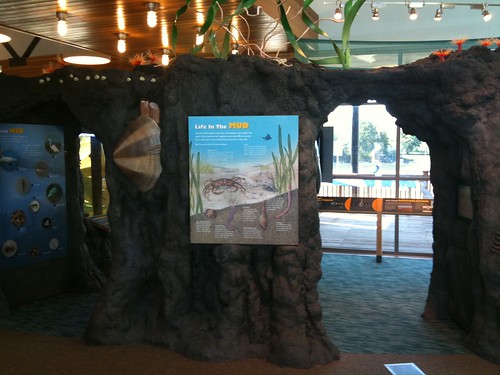
As you enter the library you are confronted by a giant interactive educational display about the ecosystem of the surrounding estuary. This structure reminds me of one of those science museums in San Francisco or the Monterey Bay Aquarium. Right away it creates a sense that I’m entering a new kind of space and creates a great distinction between the outside world and the educational world of the library.

Is it a library?
Is it a library?
I took this picture because from this angle there are no books or computers or any other indication that there is a whole library connected to it. This is the entrance into the library from the community center area where I regrettably did not take any pictures. Also, to my right (you can’t see it) there is a little cafe that will be opening soon selling coffee, snacks, etc… with a nice eating area looking out over the estuary and the local wildlife. I didn’t take a picture of the cafe either as it was closed and I want to see what its like when it opens.

Book Display
Book Display
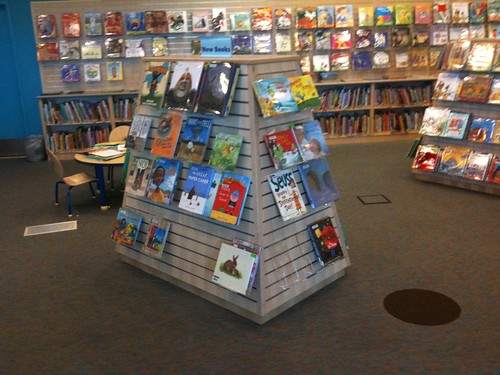
I really like these book display pieces. I would like them even more if they were on wheels so they would be easy to move when programs happen. But they do seem to work really well for showcasing materials and it seems like each side could have a different display. For example, in the kids area, one side could be trucks, the other side could be rockets, the third side could be dinosaurs, etc… In this case they are using the display to show their new children’s picture books which I think also works well. (PS… apparently, I heard a rumor, that a library in our system is getting them on wheels but not mine, oh well…)

Teen Seating
Teen Seating
I kinda of like this change of focus in the teen room. Away from the books and seating arranged for reading, and more integration of furniture surrounding the new technologies. While I despise television with the flaming hot passion of a thousand burning suns… The teens don’t feel that way, and they have game systems hooked up and can watch movies.

I also love these chairs. I took more pictures of the them, but somehow they were lost into the abyss of the internet from my phone. We were told that these chairs are a year old and they don’t look much past a day. Apparently, they are very strong and sturdy. They also lend themselves to being repositioned where the teens like them and they can be sat in a number of different ways and that really the kind of flexible seating/work areas that I really love.

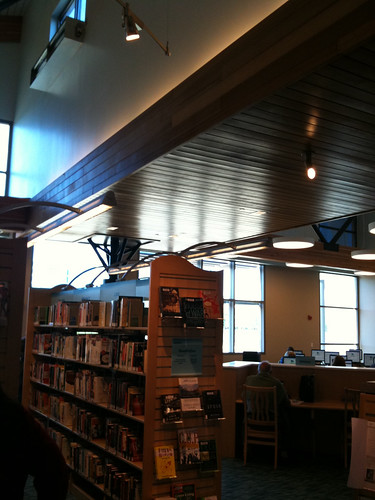
Lighting on Bookends
If I had to pick one complaint about the library it would be it’s almost great lighting on the bookends or displays. But this is typical of almost all libraries I have ever been in. I’m going to write a blog post on the EXTREME importance of library display lighting and all of libraries failure to light their libraries well for marketing. But in this example, you can see there is a spotlight *almost* facing the endcap in a perfect position to light it up properly. To be fair, in other areas of the library there are quite a few well-lit book cases and overall I was very impressed with the lighting.

There are many more things I could have taken a picture of in this beautiful library such as the boat and lighthouse themed children’s programing area. But when I looked at the pictures, they really don’t do it any justice and its really something you need to stand in front of (and go inside of) to really appreciate. Also, I was really impressed with the configuration of the computers in a semi circle (like the airport signal indicator on a mac) facing a very nice aquarium and some beautiful big windows with fantastic views.

If you do want more pictures there are tons on flickr taken by far better photographers than me. Here is a link to a bunch of Redwood Shores Library photos.

Library locator iPhone application

I just found an iPhone application that locates all of the libraries around you. This application was designed by a mother who was frustrated with trying to find libraries near her while she was out driving with the kids.  The concept is simple, if the kids are screaming in car, she can now find a library for them to scream in!   Actually, I think this application is fun and simple and very handy for mothers who are looking for something fun, educational, cheap and close to them wherever they are.  Interestingly enough this app is called simply “library.” While I’m a little disappointed in some of the functionality of it, overall I think it’s going to be fun to use when I go to some of my conferences this year. I plan on touring a bunch of libraries when I’m in Monterey, Los Angeles, Boston and Washington DC at the conferences this year. So I’m going to try it out while I’m out there.

Because this application is only a quick way to find the libraries closest to me it will make it about 10 seconds quicker to find the libraries than if I didn’t have it. Thus saving me a total of about 5 minutes throughout the year. If I didn’t have the application I would have to go through all the trouble of opening Google maps and actually typing the word “library” into the search feature. This application saves me that trouble!

Actually, the only thing this app does is open Google maps and pin drop the libraries around me. What I wanted was an application that would find libraries in places further away from me so I could plan some road trips accordingly. For example, I could have the option of typing in a city or zipcode or something and it would locate all the libraries in that city. This app doesn’t do that. It only finds ones within a 4-5 mile radius and that is a little frustrating. I also wanted to be able to maybe link to their programs and services listings for that day, or even the catalog.  But that would require some changes on the library’s part and I can hardly blame the programmer of the application for that.  But then…. I guess… How many people plan road trips visiting libraries? Wow, I need a hobby!

Here is the Link to the “Library” Application

Does Library circulation = library sales? What do you think?

First, let me say that I absolutely love the idea of libraries following a bookstore model so I’m already coming from a biased opinion. I think that, in general, libraries have a lot to learn from all retail businesses about getting our resources off our shelves and into the hands of our patrons. In fact, I would even go so far as to relate an item circulating in libraries making a sale in retail. It seems to me that having the objective of increasing the number our library materials coming off of our shelves in an efficient manner is the same thing that retail stores are attempting to do with their sales. If that’s true, and a library wants to increase its circulation or its “sales” maybe I should just start calling the circulation of library materials, library sales?

There are, of course, quite a few differences between library materials and retail products. For example, people have to return a library item and the item is owned by

Are we increasing Circulation or Sales?

the people of the community as whole through the government purchase and distribution of it. The item can be “re-sold” a multitude of times and people only pay for the item if it is lost, damaged, or returned late. We try not to let the market dictate too fully about which items are purchased. And I’m not suggesting that we are competing with bookstores or retail markets because I think we serve fundamentally different purposes. But really, I think that the actual process of getting the item off the shelf and into the hands of the patron is the same as making a sale and many of the techniques of making more successful sales can be applied to increasing circulation.

In the end, I don’t think that anything would really change about the actual circulation of library materials by simply calling it a new name except that we might begin to look at circulation in a new way and our “sales” would hopefully increase. By renaming the process we might look more closely at the vast number of more refined techniques that retail stores (not just bookstores) use to get their products into the hands of the people in their places of business. Perhaps by simply renaming the movement of the library materials we will get librarians to start thinking about using some of those techniques more often. So maybe from now I won’t “check out books,” instead I’ll “make sales.”

Of course, I could be wrong. What do you think?

Branding Libraries: Final Steps- Live the Message! – Measurements – Conclusion – references

Live the Message

Remember the brand name is also a promise about the library’s services to the community. Because of this that promise can never be broken. It must be shown through not only the brand image, the logo, the advertising, but also through the person-to-person interactions with the public while they are in the library. Any action that takes place in the library where a customer interacts with a librarian is an example of the pledge to maintain the promise of the library services. This means that every librarian on duty at all times must fully understand what the brand image that the library is attempting to project is and work every time with every customer to continue telling the story of the brand to the customer. By understanding that the staff has the ability to make or break the brand (as shown with the Abercrombie example earlier) they can make better decisions about their interactions with the patrons.

Measures and Measurements
Once the brand has been established and the plan is put into effect the job becomes one of continuously measuring the brand’s equity against that of the competitions and against itself. This measurement can be done through a number of ways. It can be accomplished through a variety of market research methods such as conducting market surveys, studying the sustainability of the library brand, and conducting focus group research to get an idea about the public’s perception of the library in their community. If it is found that the results of the measures are not the same as the library would like then the process becomes one of measuring the weakest areas for possible improvements and making adjustments in order to make those improvements. This is an ongoing and continuous process for the maintenance of the brand’s image and should not stop once the measures produce the desired results. If the desired results are found then the measurements must continue so that any noticeable slippage in the opinions of the public can be acted upon immediately to re-improve the brand’s image.

Conclusion
With a well-branded image of libraries the public can be given a sense of the importance of the library within their community. This kind of definition of image can lead to a number of benefits for the library including an increase of circulation and use as well as the potential for a renewed interest in the services of the library within the community. This in turn can lead to improved voting records for the library and eventually the potential for improved funding.

References

Allbusiness (2006). What is a brand? Retrieved November 17, 2006 from
http://www.allbusiness.com/marketing-advertising/branding-brand-
development/416-1.html

Chominskey, Dennis (2002) Cyberbranding essentials. Retrieved November 13, 2006
from http://www.phptr.com/articles/article.asp?p=30023&rl=1

Dempsey, B (2004). Target your brand. Library Journal

Gobe, M. (2001), Emotional Branding: The New Paradigm for Connecting Brands to
People. New York: Allworth Press.

Hendry, C (2006). Create your own brand. Wards Dealer Business

How to create a logo (2006). Retrieved on November 10, 2006 from
http://www.hotwebdesigntalk.com/logo-brand-identity/8-how-create-logo.html

Kirkendall, C. A. (1986) Of Princess Di, Richard Dawson, and the Book Review Digest
Research Strategies

Kranich, N. (2001). ALA at your library. Retrieved on November 13, 2006) from
https://cs.ala.org/@yourlibrary/nancymessage.cfm.

Lindstrom, M (2005). Brand Sense; Build powerful brands through touch, taste, smell,
sight and sound. New York; Free Press

Muniz, A. M. O’Guinn, T. C. (April, 2001) Brand Community. Journal of Consumer
Research

Roberts, K. (2004), Lovemarks: The Future Beyond Brands. New York: Powerhouse
Books

Schau, H. J. ( March, 2005) Religiosity in the abandoned. Journal of Consumer
Research

Walker, S. Lawson, L. V. (1993)MC Journal: The Journal of Academic Media
Librarianship, v1 no.1, Spring 1993:16-28

Underhill, P. (1999) Why we buy; The science of shopping. New York, Simon and
Schuster

All Previous Library Branding Posts

Branding Libraries: Step 1 – Defining Branding

Branding Libraries: Step 2 – A Brand Audit

Branding Libraries: Step 3 – Quality Products/Services

Branding Libraries: Step 4 – Library’s Brand Distinction

Branding Libraries: Step 5 – Owning a Phrase 

Branding Libraries: Step 6 – Tapping into Emotion 

Branding Libraries: Step 7 – Building the Libraries Brand Image

Branding Libraries: Step 8 – Advertise the image

Branding Libraries: Final Steps- Live the Message! – Measurements – Conclusion
Branding Libraries: Step 7 – Building the Libraries Brand Image

Finally we can begin to discuss the creation of a logo, a memorable name, and maybe a tagline although the logo can be all three at once. If it is not then each of these must communicate thoroughly and concisely the essence of the library’s unique selling proposition. The logo of the library should represent everything that the library does. If we look at the business model we can find examples of logos that represent and embody the companies entire ideal. One such company is Nike with its “swoosh” that represents movement, speed, agility, and all around athleticism. In the same way the libraries logo should suggest some kind of community meaning, define the mission of the library, and set the tone for the entire company. Also, it should be understood that this logo is used to enhance the consumer’s impression of the library.

“Ideally, your company logo enhances potential customers and partners’ crucial first impression of your business. A good logo can build loyalty between your business and your customers, establish a brand identity, and provide the professional look of an established enterprise.” (How to Create a Logo, 2006)

So, how should a library begin the process of creating a logo? The first step is to look at the logos of other businesses with similar goals, missions, and commitments. For example, if we look at the logos of other book suppliers we can see that the logos are largely text based. Border’s, Amazon’s, and Barnes and Noble’s logos are all textual in nature. The logo’s communicate the name and image of those companies and they are clean and functional. By clean functional I mean that the logo is reproducible, easy to scale, it is memorable and distinct in such a way to be as recognizable on business cards as it is on a billboard on the side of the road. There are no complex graphics, clipart, or photography that take time to decipher the meaning of or understand without looking for some time. The simplicity of their logos allows them to be understood wherever they are seen no matter how long or short of time they are looked at.

This type of simplicity and usability is important in a logo because the logo should be everywhere the library products are, or wherever there is a point in the community where they could be reminded of the library. For example, if we continue to look at corporate bookstores as the model brands we will notice that while in the stores we are continuously surrounded by brand images. The logo is on the books, it is on the bags, the walls, windows, signs, outside of the store, in fact it is on every possible customer touch-point. This is what connects the company to the logo of the brand and through the brand to the customers.

Since the logo should be everywhere library patrons are it is important to understand that in many places this logo is the “face” of the library. In other words the logo must do a number of things. The first, and perhaps most obvious is that the since brand image must remain constant to keep from telling a confusing story then the logo must remain constant. Second, the logo must communicate the brand story in some way. And third, it must be continuously connected to the library itself.

All Library Branding Posts

Branding Libraries: Step 1 – Defining Branding

Branding Libraries: Step 2 – A Brand Audit

Branding Libraries: Step 3 – Quality Products/Services

Branding Libraries: Step 4 – Library’s Brand Distinction

Branding Libraries: Step 5 – Owning a Phrase 

Branding Libraries: Step 6 – Tapping into Emotion 

Branding Libraries: Step 7 – Building the Libraries Brand Image

Branding Libraries: Step 8 – Advertise the image

Branding Libraries: Final Steps- Live the Message! – Measurements – Conclusion

Branding Libraries: Step 6 – Tapping into Emotion

As pointed out earlier, perhaps one of the greatest areas of improvement would be the inclusion of emotional content in the creation of a library brand. To do this we must develop emotionally accessible attributes for the brand. This means that the brand should readily tap into the target market’s psyche and evoke an emotional response.

To look at the business model literature we can see a very large discussion of the importance of emotional branding. In fact, “over the last decade, emotional branding has emerged as a highly influential brand management paradigm” (Gobe, 2001). This is in large part because connecting the products to the emotions of the consumers creates a more experiential experience of the product. By doing so the consumers connect to the product and the product itself becomes a part of the consumer’s identity. Therefore, for a consumer to leave to brand would now mean that the consumer loses a sense of identity. In this way “emotional branding is a consumer-centric, relational, and story-driven approach to forging deep and enduring affective bonds between consumers and brands” (Roberts 2004).

The idea of the library as a community driven organization can actually work to benefit the creation of the brand identity. This is because “proponents of emotional branding proclaim that this high degree of consumer passion is seldom, if ever, cultivated through rational arguments about tangible benefits or even appeals to symbolic benefits, such as heightened self-esteem or status” (Gobe 2001). Instead we see that “these potent consumer–brand linkages typically emerge when branding strategies use narratives and tactics that demonstrate an empathetic understanding of customers’ inspirations, aspirations, and life circumstances and that generate warm feelings of community among brand users (Muniz and Schau 2005).

Where better to generate warm feelings of belonging and community than within an organization that has this as its main goal. The library should be presenting in a continuous narrative to the consumers that the library is not only a community-centered organization but also that when they use the library the users are a part of the community. They belong to the community, and the library is their key to that sense of belonging. So how can this story be told?

I would argue that perhaps we can convey this message through partnerships with the community, or through partnerships with other community organizations. These partnerships would have to be with organizations with similar goals of the library such as education, community building, literacy, etc. If the library partners with organizations that do not have the same goals then it is possible that the story gets confusing or diluted and the brand identity of an organization as a place in jeopardy since the consumers will no longer understand the story being told to them through the brand story.

All Library Branding Posts

Branding Libraries: Step 1 – Defining Branding

Branding Libraries: Step 2 – A Brand Audit

Branding Libraries: Step 3 – Quality Products/Services

Branding Libraries: Step 4 – Library’s Brand Distinction

Branding Libraries: Step 5 – Owning a Phrase 

Branding Libraries: Step 6 – Tapping into Emotion 

Branding Libraries: Step 7 – Building the Libraries Brand Image

Branding Libraries: Step 8 – Advertise the image

Branding Libraries: Final Steps- Live the Message! – Measurements – Conclusion
Branding Libraries: Step 5 – Owning a Phrase

Next in developing a brand, a library must own a word or phrase. When we are defining our message, we are trying to own a single word or short phrase in the mind of the target market. To say “own,” I mean that no other company could ever use that slogan to mean anything else other than what we have conveyed it to mean. By analyzing the strengths of the distinctions, and by understanding the role of libraries as community organizations I might argue that a strong choice would be; “Libraries ARE the community” or “The library IS the community.” This message conveys some of the same aspects of power that Nike conveys when they say “Just Do it.” It also promotes the ideology, and the mission of the library in the same way that “The Ultimate Shopping Experience” does for the Seattle shopping center Pacific Place.

If this hypothetical phrase is the one to be used then the next step would be to be sure that it is not owned by anyone else. Or that it has ever been owned by anyone else. Obviously, if it is already in use by another organization it can’t be used because it would simply cost too much in promotions, advertising, money, time, and effort to change the meaning in the minds of the patrons to that of fitting the library. It is clear that with such a slogan as “Libraries ARE the Community” it is unlikely that it has been used by any other organizations but it is important to understand if some other slogan is what will be used. Also, if the slogan has been used in the past by an organization that lost public favor such as Enron or the like then it should not be used either. This could lead to an association with negativity and that is exactly what a brand wishes to avoid.

All Library Branding Posts

Branding Libraries: Step 1 – Defining Branding

Branding Libraries: Step 2 – A Brand Audit

Branding Libraries: Step 3 – Quality Products/Services

Branding Libraries: Step 4 – Library’s Brand Distinction

Branding Libraries: Step 5 – Owning a Phrase 

Branding Libraries: Step 6 – Tapping into Emotion 

Branding Libraries: Step 7 – Building the Libraries Brand Image

Branding Libraries: Step 8 – Advertise the image

Branding Libraries: Final Steps- Live the Message! – Measurements – Conclusion

Amazing video! Range and Scope of Change in Technology. #library

Whenever I see one of these videos I always wonder how I can possibly keep up without taking on learning technology as a full time job.  I also wonder how libraries or other organizations are supposed to keep up without having a full time position dedicated to learning and implementing new technologies.  This is not to say that every technology needs to be used or even that every technology should be used.  But this video confirms my belief that organizations need to be quicker to respond to changes in technology, and a full-time staff person would be a great way to ensure that this happens.

Info about the video

“This is another official update to the original “Shift Happens” video. This completely new Fall 2009 version includes facts and stats focusing on the changing media landscape, including convergence and technology, and was developed in partnership with The Economist. For more information, or to join the conversation, please visit http://mediaconvergence.economist.com and http://shifthappens.wikispaces.com.

Content by XPLANE, The Economist, Karl Fisch, Scott McLeod and Laura Bestler. Design and development by XPLANE, http://www.xplane.com. You can follow us on Twitter at http://www.twitter.com/xplane”

Branding Libraries: Step 4 – Library’s Brand Distinction

 Next libraries need to identify their brand’s distinction. This means that libraries must define their message and position while determining what it is that sets them apart from the competition. This distinction is the potentially branded product. So, to determine what the distinction is, libraries need to ask themselves; are they the first, best, most innovative, or luxurious in the category of companies performing similar functions in the community?

The First

It looks as though libraries have two services that are important to the target market. These being free access to information and also as a community centered organization. So to answer this question, I might say that actually libraries were the first at providing free access to information within a community. Having been in existence as a concept for thousands of years libraries have had very little to compete with as far as firsts in freedom of information. However, as a community centered organization libraries might not be the first or the original. There have been gathering areas within communities since the beginning of communities, whether it was the tribal fires where members would gather for stories, the Stoa where Socrates gathered members of the Greek community to teach, or any of the other millions of examples of community gathering places throughout history. So we need to recognize that while libraries are viewed in the public’s perception as places of information they still do have heavy competition for the community’s view of libraries as a first in community gathering places.

The Best

Once again libraries are the best at providing free access to information. Even with the invention of the Internet, libraries are more cost effective when quality of information is taken into account. Also, for the patrons, libraries cost nothing (outside of time) if the patron wishes to use a computer to access the Internet. Unlike a home computer that can cost thousands of dollars before access can be had, and even after this startup price there are still monthly fees the library is free no matter what the patrons financial status. So libraries are the best at providing free access to information, but how are they as a community center? This may be the libraries advantage. Although community centers have been around for thousands of years, in the current society there are very few community-centered organizations that work to provide services for the betterment of the community or as points of gathering in the community that are as good or comprehensive as the library. The library may not be a perfect community centered organization but they still may be on of the best.

Innovative

Libraries downfall may be that they might be one of the least innovative information sources available. There are a number of libraries that do not have enough (or any) of the latest technology to access or use information. With the constantly changing information age storage formats are outdated and useless at a much quicker rate. This means that libraries must continuously be innovative and keep up to date with information systems as well as being innovative in creating some of their own. On the other hand, libraries are very innovative when it comes to being a community-centered organization. They are so much so that oftentimes the successful community programs developed by the library are integrated in to private businesses such as bookstores, and after school literacy programs.

Luxury

Lastly, the luxuriousness of libraries is on the increase with such library systems as San Jose, San Francisco and Chicago. These types of systems are highly luxurious and are oftentimes destinations themselves simply because of the luxuries they offer. With this understanding of the distinctions of a library they can then continue to move to distinguish those distinctions in the minds of the patrons. By promoting the fact that libraries are the first at providing free access to information, or by selling the community empowerment of a library, they can help develop the library brand’s meaning for the patrons.

All Library Branding Posts

Branding Libraries: Step 1 – Defining Branding

Branding Libraries: Step 2 – A Brand Audit

Branding Libraries: Step 3 – Quality Products/Services

Branding Libraries: Step 4 – Library’s Brand Distinction

Branding Libraries: Step 5 – Owning a Phrase 

Branding Libraries: Step 6 – Tapping into Emotion 

Branding Libraries: Step 7 – Building the Libraries Brand Image

Branding Libraries: Step 8 – Advertise the image

Branding Libraries: Final Steps- Live the Message! – Measurements – Conclusion