At the time of writing this blog post, I’ve read two articles on the death of reference. The first was called “Is Reference Service Dead?” by Mathew Ciszek and the second was by Michael Stephens and it was called “Stuck in the Past.” Even I wrote a reference is dead blog post once many years and two other blogs ago. So, if reference is so dead, and it’s been written about as long as I can remember, why are we still talking about it? I think there are four choices.
1) It’s not dead
2) We haven’t come up with something better
3) Folks refuse to let it die
4) Students in Library School who think it’s something new to write about
Here is where I tell you which one of the four that I think is true. The truth is, I don’t know. I’m pretty sure that it’s a little of all four but my thought is that mostly its number two. I think there is something better than reference services and it ties into a future post that I’m working on. But, here is the reference version of that future blog post.
Eli Neiburger of the Ann Arbor Library District argues that armed with Google and an internet connection, the need for reference librarians has diminished. “Travel agents were outmoded because people felt they had better access to the information than they could get from the travel agents”, he said, and just as travel agents have become a thing of the past, so will the anachronistic reference librarian. With everything on Google, who needs them? (from Ciszek’s blog)
My thought is, he’s right! Who does need them? Lonely seniors and folks who can’t or don’t know how to access Google might need them but for the general public, the crap they dreg off the bottom of the information sewer on Google is good enough for them. Even though it might be wrong, or poorly written (like this blog), or out-of-date, or an ad for a guaranteed weight loss solution, they are satisfied with what they now “know.” Really, and I hate to break this to folks, but it’s all about perception. If the perceive that they have what they need, then that’s all it takes.
I’ll add in as a side note, that I do wholeheartedly disagree about the whole IT hiring frenzy thing though
But don’t worry; I’m not about complaining I’m about answers and solutions. So, here is my solution –
Reference is dead, long live the enabler.
Before I get more into my thoughts here, I can’t even begin to tell you how important it is for librarians to watch this video. So please, I’m begging you to watch it. I blogged about it once before, but here it is again.
So if we don’t have reference as a core service, then what do we have? We have the ability to enable people to live more fulfilled lives. We can do this by providing answers (some forms of reference), materials for better lives (more extensive collections like guitars, tools, seeds, gaming, augmented reality), a third place (a quiet work or relaxation place away from kids and husbands and wives), and a place to learn with the resources they need to learn (isn’t this really what we are about at the end of the day?). Hey Michael, notice I didn’t mention books?
What I’m saying here in a round and about way, is that we need to continue what libraries have always been, and that is to be enablers to those who want to learn and provide the resources that enable our communities to learn. It’s not reference, its enabling our patrons to live more fulfilling lives. After all… By answering reference questions wasn’t that the real goal anyway?
This is my grant narrative for the East Palo Alto E-Reader Lending Library. This opportunity arose because a neighboring library had a friends group with unspent funds from a grant. The money needed to go towards the implementation of some kind of technology. Basically, I know that a few other librarians have started some kind e-reader lending library and I wanted to jump into the e-reader fiasco sooner rather than later (we saw what happened to borders) so I put this grant idea together.
Short Description –
A set of E-readers with high-demand subject-specific content pre-loaded to check-out to community members.
Long Description – The East Palo Alto Library, as a branch of the San Mateo County Library, seeks to create innovative and exciting collections to engage our users in ways that meet their changing needs. We have established unique collections as part of the East Palo Alto Library that includes a Seed Library, circulating laptops, and a newly implemented Guitar Lending Library. By expanding our unique collections to pre-loaded and high-demand subject-specific e-readers we are seeking to engage the public with resources that they may otherwise lack access to. Some of these non-fiction resources would include career- and job-seeking guides, as well as cooking, entrepreneurship, business management, and travel guides. Besides non-fiction, the East Palo Alto Library has a high demand for some genres and authors of fiction materials as well. Some of these include many urban fiction series, mysteries, thrillers, and various authors within these genres. These kinds of collections can help adults with their educational and recreational resource needs.
Besides providing e-readers with content that is exciting to adults, some e-readers would be pre-loaded with many titles and genres that would interest children and teens. Children are growing up in the information age and are considered information natives in the ways in which they interact with digital mediums. With this understanding we can appeal to the techno-appeal of digital environments by providing student resources, picture books, early-readers, and fiction materials for both teens and children.
It is also becoming increasingly evident that seniors are re-discovering the joys of reading through the use of e-readers. These devices are becoming more simplistic to use for those older adults not familiar with digital media and as the boomers (who are techno-savy) age, we are seeing an increase in retirees with strong computer skills who are enjoying reading on digital devices. Also attractive, is that the easy-to-read e-ink text on the devices can be effortlessly increased in size for easier reading for individuals who may have hardships of sight.
E-readers also lend the library with interesting and new opportunities for collection development. The “collections” kept on the e-readers can vary widely and because an e-reader can hold up to 3,500 books, many varied collections can be kept on one e-reader. These collections are easily and cheaply interchanged if needed and can be supplemented with many of the free e-book resources found online as well as through access to the library’s Overdrive digital book resource. These kinds of innovations will allow the library to continuously interchange collections while not being forced to throw away or weed existing collections thereby creating a greener organization as well.
My big questions that remain are…
What percentage of funds do I put towards the pre-loaded e-reader collection?
What percentage of funds do I put towards e-readers?
And most importantly, which e-reader do I purchase?
The third question seems to be the most difficult one to answer. Do I go with popularity (Kindle), ease of use (Nook), more exciting for children (Nook Color), and there are so many other variables that I really don’t know where to begin to start researching this. So I purposefully left out, which device I’m planning on purchasing.
More info…
If you haven’t followed ALL the e-reader debate in its all encompassing and over-passionate glory (neither have I, it’s just too overwhelming) here are some good places to start.
Patron Generated Check-out Lengths While writing my last blog post I had another idea spurred by the need for an extended check out length for the business book bins. I realized (as I’m sure many of you have as well) that many different patrons read at different speeds and check out books and resources of varying degrees of length and difficulty. Not only that but, many patrons are working on research projects that might take longer than the standard the 2 weeks or 3 weeks that a library assigns to all of its books. The problem here is that we have invented one sized shoe in a world where people have different sized feet. But what if the patron could decide what sized shoe they wear? Or, what I really mean is, what if the patron could decide what length of checkout their items had?
I feel like this would be fairly simple to accomplish in many libraries. Basically when a patron checks out an item they would type in their preferred due date. They could choose however long that they figured it would take them to read the book or finish their project. Of course, I suppose some limits should be set. I wouldn’t want someone checking out a book for a hundred years or anything but I would love to see the length of time be set to something much longer than it currently is.
It seems like this would solve a lot of problems. In this system, since the patrons pre-determined their own due date they could remember it better and not have that argument at the counter about not remembering when their books were due. They would also be able to have the item for the length of time that they need it and they couldn’t complain about not having enough time to finish it or their project. It would also mean that when there are holds on the item (thus negating the option for renewals) the patrons could still have the time to do what they need to do.
In contrast to a no fines system
One of the other solutions is a no-fine system. Well, yeah right! Try to get that to fly with budgets being so tight and cities thinking that library fines are a money making system to supplement their new crosswalk project. I think that no-fine systems are good for a number of reasons, but in real-life I have seen some problems arise that I won’t take the time to outline here. So, I would think that we could still issue daily overdue fines and fees as a way to get materials returned, but patrons would have more power over their charges and I’m always for power to the people.
The Big Problem
The most glaring obvious problem here is the circulation software. This option is definitely not set-up in the software for patrons so I doubt this idea has any real legs to run on. Maybe some of you out there can get someone to try it out at your library? I don’t know, that’s a vendor fight that we would never win, but if anyone wants to take it on, be my guest.
Purchases from The Library Advocate Support Library Advocacy ProjectsPunk-Ass Book JockeyThe Dark Ages Began with the Closing of a LibraryYour Library is Your Portrait..
I read a great article about businesses starting their own libraries of business books in the office and it spurned a thought that I wanted to share with anyone in a community with a large number of businesses. It’s pretty simple and I’m not sure it requires an entire blog post dedicated to it, but I need to write something here anyway and I want to write this idea down before I forget it. Basically the idea is circulating business book bins. (Self-explanatory! That might be all you need to read here. But if you want more, please continue)
So, you know how libraries circulate those subject specific boxes for schools when the school is doing a big research topic on something like reptiles? Well… What if we did the same thing, but for local businesses? These bins, or boxes, or bags, would be filled with books and resources for businesses big and small to circulate to employees. Each bin could have a different subject in it such as marketing, leadership, management, etc… In fact, we could even have bins for folks who are starting up their own businesses that could be filled with books about start-ups that could include things like NOLO Guides and books on business plans and models. *Thus the library could be the source for renewed entrepreneurship in America, eventually saving the American Way and Dream, the American economy, and in fact, America itself!!
Anyway, I think it would work something like this. The library would put together these various bins and send letters to local businesses advertising this new service listing the various business topics. Each bin would have a collection of books on a specific topic, but only the bin would need to be barcoded because they’re checking out that subject collection in total. There would be a list of materials with a checklist included in the bin to ensure they all get returned. The business would call the library and request a specific topic bin and the library could drop it off. I would love to have the business determine the length of the checkout (which leads to another blog post on check-out lengths later) so they could ensure that they have enough time to have each of their employees read the material. This would be important because businesses of different sizes can have any number of employees and it would take differing amounts of time to circulate the materials throughout the business. At the pre-determined due-date the library would pick up the bin of books. And that’s it. Super easy.
Of course, we might have to make someone from the business come to the library to get the bin instead of going there. I understand those kinds of time constraints. But! I think that, by going to the business, we have the opportunity for a new kind of outreach like we do in schools where we can have a stronger presence in their organization. When we go to the business we can do a small presentation to the staff on other resources that the library has to help them with their jobs. This would almost be exactly the same thing as a school visit but for adults!
Ok… Here’s the part where you tell me what you think… And go!
*Alright, maybe I get a little carried away. But I still believe that libraries are one of the most important institutions in the United States and do actually have the power to vastly improve the state of the country.
Purchases from The Library Advocate Support Library Advocacy Projects
When I attended the Eureka! Institute we gave a presentation at the end about innovative ideas in libraries. Our group had a whole bunch of them and I presented them. The response was “it seems like your trying to save the world.” I kept my mouth shut, but what I thought was “Well… Yeah, we are!” I mean, I am obviously biased, but the intense amount of good that a library does is why I got into librarianship in the first place. Anyway, the reason I’m writing this is that I have once again found that libraries are one of the only institutions that can save the world.
I was watching a Ted presentation by Tim Jackson called Tim Jackson’s Economic Reality Check. While I totally agree with so much of what he says and am so excited to throw away my stuff and move aboard my boat for a couple months (Henry David Thoreau) I am more impressed with his statements at the end of his presentation. These statements make it perfectly clear that libraries, once again, are going to be the savior of humanity. But only if librarians allow them to be.
Basically, it comes down to people’s ability to achieve a new kind of fulfillment beyond material goods. We need to begin to not only provide the information to allow people to fulfill the needs in their life, but we also need to provide the materials they need. After all, what good is a book if you don’t have the resources to learn from them? I’m suggesting that these materials are our collections beyond books. Things like seeds, guitars, tools, video games, and maybe even augmented reality. But, as a great man once said, “You don’t have to take my word for it.”
Purchases from The Library Advocate Support Library Advocacy ProjectsShow your support of libraries!Awesome Library GearGreat Staff Gifts!..
In case you haven’t heard (read) me mention it on Twitter or Facebook I’m putting together a collection of circulating guitars for my library. If anyone is interested, here is some background on this project, what I’m planning, and how we’re moving forward.
History
While working at Lincoln Public Library my director and I had a discussion about various innovative collections we could start at the library. We had a great space and some good ideas but we weren’t sure how to implement them. Some of our ideas included video games, tools, and other musical instruments. The biggest barrier to us starting this collection was that we just simply didn’t have time. We were running a 40,000 square foot joint use building with a huge circulation number, a large amount of acquisition and cataloguing work, and just about everything else that comes with not only a brand new building, but a new staff and a new library system. Did I mention there were only 2 full time staff members? Anyway… Those are the reasons that Lincoln Public Library doesn’t have a guitar collection.
The good news is that East Palo Alto Library in the San Mateo County Library system where I now work will have a collection of circulating guitars. It was all made possible by my involvement in the Eureka! Program that is allowing me to apply for a five thousand dollar LSTA grant. This grant will be the seed money to start my collection. What follows is the VERY rough draft of some of the information that I compiled for the grant.
Basic description of the project
The East Palo Alto Library will create a collection of guitars as well as offer two 8-week beginning guitar group lesson programs to include both those individuals who already own guitars and those who have checked-out the EPA guitars. There will also be 4-6 one time programs throughout the year that are focused on music. These will include performances, movies, artist visits, and game nights (Rock Band).
Background
The project was identified as a need due to the lack of music programs for youth in the East Palo Alto community. Music classes are no longer offered at local schools and there are no local businesses that offer music lessons or sell musical instruments. The economic status of a large percentage of East Palo Alto residents makes it difficult to gain access to expensive music lessons as well as the instruments themselves even if such businesses did exist within the community.
However, this community has a long and rich history with music as well as a cultural identity in music. East Palo Alto is home to one of the largest populations of Pacific Islanders in the continental United States and Polynesian music has played a significant role in the culture of East Palo Alto with performances by local groups at churches and various community gatherings. There is also a significant Spanish speaking population that performs various forms of Spanish music. The African American Population in East Palo Alto has had a significant effect on the music since the early 1950’s when this population became the most prominent. Each of these stylings of music has led to a blended genre of music that is being performed locally by such bands as the Vintage Music Collection and the Hip Hop Orchestra. (Two groups brought to my attention by Sereptha Strong who is one of my librarians named)
These are not the only groups in East Palo Alto. In fact, there have been a number of self-taught musical groups that have arisen from within the community. The most prominent of some of these groups are primarily rap and hip hop groups such as Totally Insane, Sean T, S.I.C, Mac & AK, The Youngen, Chunk, Bigg Rigg, Band-Aide, Scoot Dogg, Ad Kapone, and Mac-10.
Many families gather to play instruments that have been handed down from generation to generation, and there are some residents who offer their backyards to local performers as a stage. There are also few homemade musical venues such as the House of Bigger Girls and some churches allow musical performances.
Moreover, music has been cited as a way for youth to express themselves in a positive and creative way. There have been numerous studies that have shown that music can act as a deterrent to violence. This, coupled with the understanding that EPA was the murder and violent crime capital of the United States throughout the 90s shows that there is an inherent need for a musical outlet.
Anticipated outputs and outcomes
For the Community
Patrons who check-out guitars and participate in the 8-week group music lessons should have a basic understanding of tuning, parts of a guitar, major and minor chords, a few chord progressions, a number of strumming and picking patterns, a number of scales, and few basic songs.
Many other larger community benefits of music have been identified however, the measurements of such benefits can be difficult to quantify. A list of the potential benefits to the community with supporting documentation can be found at;
Some of the outcomes listed from various studies include
Improved reading comprehension
improved math grades
Improved standardized test scores
Improved social Skills
Many of these outcomes are difficult to measure, and in no way am I making the argument that this program alone will have the ability to accomplish all of these things in a short 8 week program. However, this program could be a small contributing factor in the growth and improvement of our community.
For the Library
Increased Circulation
Increased level of programs and services
Increased number of partnerships with EPA organizations
Some identified community partners
We have identified a number of organizations that have expressed interest in partnering with the Library to provide these programs. There are a few local bands/artists who would like to volunteer to teach group lessons. Other organizations who have expressed interest include
Sassy
JobTrain
YMCA
Ravenswood school district
Stanford
Budgeting
This is the part that I’m most excited about right now. Just the fact that I’m thinking about the budget because I’ve made it this far gets me pretty excited so here is how the money will break down.
The majority of the grant funding will be used to purchase guitars and supplies. We would prefer to find ways to have the guitars donated to the program. However, guitars may need to be purchased. Guitar starter packs from Guitar Center typically range from $150-250 depending on quality. I would like to begin the collection with 15 guitars and spend approximately $3,750 of the grant money on these guitars. That means I can spend about $250 on each guitar. I wanted to make sure that this was even possible and that I could even get a halfway decent guitar for this price so I walked across the street from my house to Guitar Center on Sunday (Guitar Center’s close proximity to my living space has not had a beneficial effect on my finances BTW) and started to ask them some questions about what kinds of discounts I could get if I bought 15ish guitars with a starter pack from them. I don’t want to say what the discount is, but the unofficial offer was very significant and might allow me to do even more. However, since the offer was unofficial I’m going to keep my $250 estimate and hopefully wind up with more money in the end to offer more classes or more learning materials.
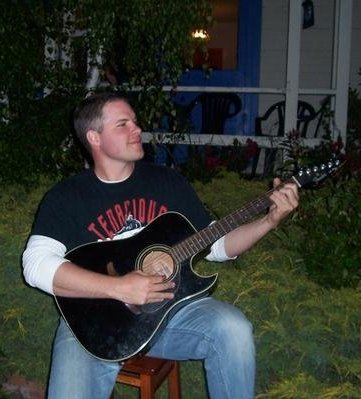
Happily playing guitar badly in my front yard in Santa CruzNext I need to buy some of the supplies that I need to display the collection and to keep the collection going. These are just basic necessities like extra strings, picks, straps, and other general maintenance supplies. I think I can get enough for the first year with around $300. But then I still need to purchase a way to display the guitars and I think that I can get wall mounts (before the discount that I’m going to ask for) for around $20 each so I need about $300 for that. So now I’m up to about $4,350
What I have left over is about $650 that I’m going to use to refresh our music learning collection. I want to purchase books, dvds, cds, magazines, etc… that will help people learn on their new instruments. I should also mention that the starter packs come with an intro to guitar DVD and I think that I will keep that DVD with packs when the patrons check out the guitars.
The last purchase that the library will be making will be the cost of the instructors for the program. I don’t want to take this money out of the grant money because it is an ongoing cost. So I’m planning on paying a guitar instructor about $30 per hour for the group lessons and I have already found some teachers who are willing to do it for that price. Even more exciting, I’ve found some teachers who have offered to do it for free! However, I’m wary of these offers because I’ve my previous experiences with flighty volunteers and I don’t want the students to miss out because the guitar instructor is a flake. So I’m budgeting $480 for two one hour, eight week group lesson sessions. I’ll let you know how that goes.
Fines and Fees
Just so you know, I’m totally against fines and fees. However, we do need to be able to maintain our strings and picks and we do need to repair any damages to our guitars, and I need to ensure that we get these guitars back. So, depending on what kind of price I can get on all of these things, I will be charging some kind of fine/fee structure that is yet to be decided.
While I don’t have the grant approved yet, I am very excited about even the possibility of having a funding source for this collection. If, in the end my grant is not awarded to me, I at least have the foundation for writing more grants! Not matter what happens with the grant, I’m pretty sure I can get this off the ground in a number of ways.
Purchases from The Library Advocate Support Library Advocacy ProjectsShow your support of libraries!Awesome Library GearGreat Staff Gifts!
This is going to be the first of what will hopefully be a long set of blog posts. In the last couple of months I have been struggling with idea of libraries as a concept. It started with a presentation I did for our librarians in the library system where I work. The presentation ended with me questioning what it is to be a library. Here began a long list of experiences that are forcing me to rethink what a library is. I am going to begin by sharing some these experiences with you. The first is (while not really the first, but the most meaningful) was meeting Sarah at ALA Annual in DC. Sarah is the Itinerant librarian and goes by the name @librarian on Twitter.
The Itinerant Librarian was one of the most inspiring people I have met at a conference. This is a person who travels the world with a “library” in a briefcase. The story she told me is that previously she had no library experience and just thought one day that the world needed a traveling librarian. So, she left her home and had no job, no money, no financial support, no “real” library backing her up and created this “library” of books that she carries with her for people to check out. I truly regret not having my flip camera on me and recording the amazing conversation we had.
She explained to me that the concept of the library is that she goes to a coffee shop, restaurant, park, etc… and puts out the books she has in her briefcase on the table and signs people up for a library card. People can check-out the books as long as she is there. When she is ready to leave, you have to return your books and she moves on to the next place. When she needed a place to sleep she used couchsurfer.com to find a place to sleep and when she was hungry sometimes she had to each out of rubbish bins (she’s English and has a great accent and I could listen to her say “Rubbish Bins” to me for days on end). She has a uniform and the library has a set of rules and regulations that all the patrons have to follow to get a library card.
You can read the rules and regulations here at the “library’s” official website: http://www.tipl.info/
When I refer to this as a “library” instead of a library, I mean that as a compliment. I mean that this isn’t a library as we think about them in the United States. The rules are different (better), the concept is brilliant, it totally challenged my concept of what a library is and can be, and her project has set in motion hundreds of thoughts and ideas for me.
Most importantly, it made me realize the importance of libraries as a concept and the little importance that a building, management, money, organization, rules, etc… have on what it means to be a library. In fact, this might be the most pure form of librarianship that I have encountered.
Materials Sorting MachingAs the second part to my post (or rant) about automation in libraries, I want to write about why I think Mountain View Public Library’s system might change my mind. MVPL uses the Libramation system for their RFID and MK for the sorting system & return software and circulate roughly 1.5 millions items out of just this one library. If you are unsure about why I dislike automated systems so much you can read my previous post. Some of this might not make sense unless you read that. Also, I want to talk about the library itself and some of the features I saw that I really loved, but I think that will have to wait for yet another post. So I’ll stick with the automation and how it addressed my concerns for this entry.
COST
I’m not sure what it cost them (I was afraid to ask) but I was doing a little math in my head as we went through it. The costs seemed to be- the sorting machine itself, book drop interfaces, RFIDs, self-check, RFID printers, construction/installation, staff training, and ongoing power, supplies, and support/maintenance costs. These are the costs that I would expect and nothing out of the ordinary and the savings typically come from the reduction in staff which was my second concern.
STAFFING
Our tour guide was the Circulation supervisor and she explained that this system did bring in a large reduction in staff time. I was unable to see the savings in action this day because we were on the tour the day after a holiday and more staff were called in for all the extra returns, but typically I was told that there was only one person in the back room managing the system with occasional pages to do the detail sorting and shelving. Also, I noticed that because they also had Self-check stations the front desk was only staffed by one person. So, from what I could tell, for a circulation of 1.5 million and only needing one paraprofessional in back, one on desk, and a handful of pages shows a fairly significant savings over the long run. This reduction in staff was mostly because the system actually works! Which is was my third concern.
THE SYSTEM WORKS!
As we were in the processing room with the machine we got to see it working first hand. To my great surprise, the machine actually worked! The books were dropped in the book drop, instantaneously taken off the patron’s record and taken on a conveyor belt were it was rough sorted into 11 different categories depending on where it belonged in the library. For example, one cart was for books in the adult non-fiction area from 0-100, the next for 200-300,Self-Check Stations etc… and holds or problems when into the last bin. The carts were then hand sorted by pages to carts and shelved. The only real glitches had to do with items being returned that didn’t belong to MVPL (which is a glitch at almost any library) and items that couldn’t be RFIDed properly because of its shape or case. This second problem was being corrected in a number of ways and won’t be a problem any more in a couple of years. The first glitch has to do with patrons using the system which was my largest concern.
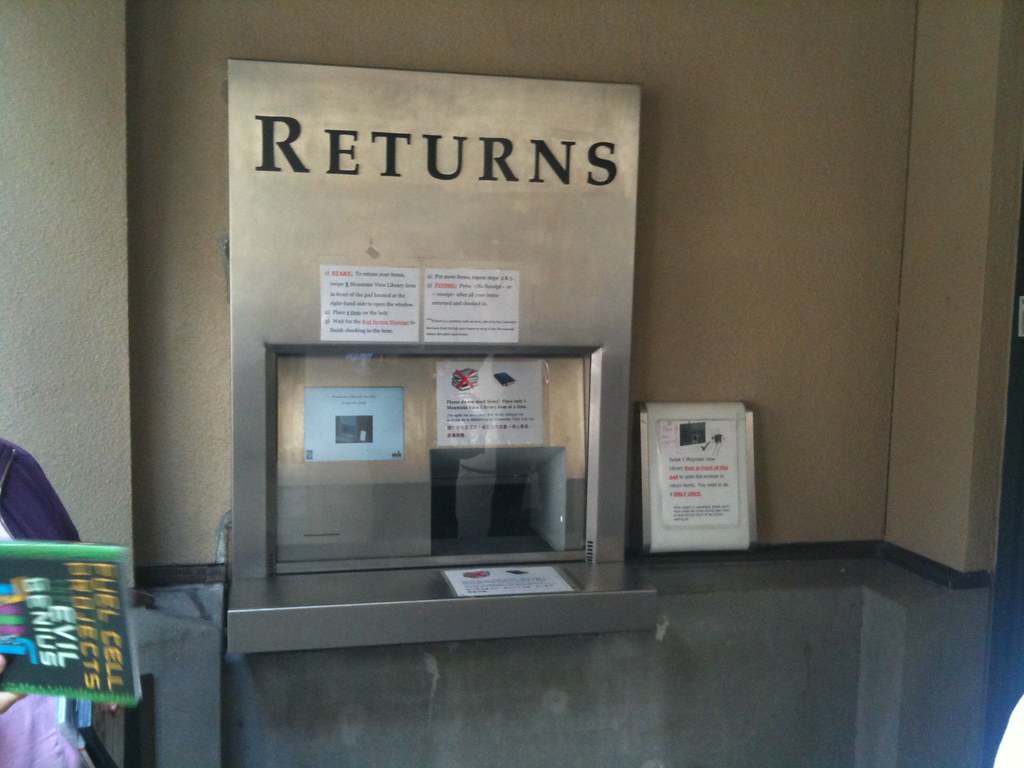
THE PATRONS Book Drop InterfaceI took a little time and watched the patrons interacting with the machines. It seemed to go smoothly but I could tell that there was a large learning curve for them by the number of signs on the book drop. I suppose this is to be expected since the new system requires a new set of rules that they had to learn. For example, the patrons had to place items one at a time on the conveyor belt for the system to work properly and a light in front made it seem that it was scanning a barcode and not a RFID. Also, a piece of drop down glass covered the machine to keep people from placing things that didn’t belong into the drop. However, when I first arrived and looked at the machine, my first thought was that it was closed and that I couldn’t use it. After a couple of minutes of investigation a patron approached and opened the glass by scanning a book on the outside RFID reader and returned her books very easily. Even with these little issues, everyone I saw that day (especially the kids) who used the self-check and the return interfaces seemed pretty happy with it all. And happy patrons + happy staff = a win in my book!
So have I had my faith redeemed in RFID and Automated Materials Handling? Maybe… However, I still think that these systems require a lot more work than the vendors tell you they do, not all of them work as well as MVPL’s, and I would be concerned that libraries who use these systems with significantly smaller circulation numbers won’t see the savings that the systems could bring. So I still recommend a fairly high level of caution when thinking about adding one of these machines to a library. Its shiny, its new, it doesn’t always work, but for MVPL, and our library system’s installation of the same system, I’d say we are very potentially making a great decision and definitely making a good well-researched decision. Way to go team!
Mountain View Public LibraryI’m always a little skeptical of automated library return systems. I’ve had some bad experiences with them and I’m never sure that they have a positive return on investment. So when our library system decided to invest in four at four of our branch locations I was a little worried to say the least. Luckily, our director made the decision to have our branch manager meetings at other libraries in the area instead of within our own library system. This lets all of us branch managers gain a little insight into the tools and techniques of other libraries and in this case, gain a more in depth look at the automated system in the Mountain View Public Library (I will review this automated system and this beautiful library in general in a post to come). This re-look at these kinds of systems made me think of my own personal history and concerns about automation and RFIDs in general.
The first concern is the cost of such a system. In my last library we used the 3M system for RFIDs and automation. The RFIDs cost $0.46 each (we had 180,000), the RFID readers cost a few thousand each (we had almost 20), the RFID printers were rented and still cost a few thousand. These costs don’t include the costs for the servers, wiring, installation, security gates, self check-stations, and software maintenance charges that total some number beyond my comprehension. At that library we didn’t have, and therefore I didn’t include the cost of a fully automated sorting system and all items fell through the bookslot and into one bin.
The second concern is that, in my experience, these systems don’t require less work from staff at all. We were told that, as the items fell through the bookslot, they would automatically be checked-in and all we would have to do is sort the items and put them back on the shelves. However, this was not case. Items in the bookdrops were only checked-in 60-65% of the time requiring all items to be re-checked manually and sorted for holds and ILLs by hand. Also, metallic items such as anything with a CD, or metallic and reflective paint would not be scannable with the RFID system. Our library system also had a second building that wasn’t RFIDed. This is a similar problem found in library consortiums where items can be returned between library systems and different brands of barcodes or RFIDs are used that aren’t compatible. In relation to the amount of work required by automated systems is how much work staff is still required to do. Generally, the items still need to be pulled that are on hold or ILL, they still need to be
My third concern is; how well does the sorting machine actually work? I’ve been to a few libraries that use an automated sorting system that simply doesn’t sort the items in a way that’s even remotely effective. The items are misfed, mislabeled, and missorted to such an extent that the librarians have simply stopped using the system. The complaints from the poor folks who are stuck with these machines are long and plentiful and filled with stories of what could have been better done with the hundreds of thousands of dollars that were spent on the non-functioning machine. Of course the vendors promised the world to these sad librarians and I’ve actually heard the vendors say at conferences that staff will never have to touch a book again! In fact, I’ve had to stop spending time in exhibit halls at conferences because I’ve angered too many venders by my questions that lead them to admit to the Music Man like lie they just blatantly made to the group of librarians who surrounded their shiny new machines that would solve every library problem ever created and sure to come.
My final concern surrounds the ease of use for the patrons who are forced to use this machine. As the librarians are already frustrated with many of these systems, the patrons forced to use them oftentimes have the same experience. Many times the system has a new set of rules that patrons must learn, the system doesn’t work intuitively or consistently, and the end result is that the patron makes a mistake, the machine doesn’t work and the patron gets blamed, feels stupid, or simply doesn’t want to learn. And honestly, who can blame them? They already have to learn how to use ATMs, different self-check systems at grocery stores, smartphones, computer programs, different computer platforms, and the list goes on.
As a side story – I was recently talking to a library director at a conference about their RFID system and she made the comment that items need to be returned one at a time through the bookdrop for it to work but patrons were putting in more. Someone asked how they make sure that items are put one at a time through the bookdrop and she simply said “oh, we made a sign.” I asked her how that worked out for her, and she said…(I’m not kidding)… “it’s a really nice sign that’s made out of brass and engraved” and then looked at me as if that settled the problem and answered my question. I’m not sure that it did, but I gained a lot of insight into how that library works with that statement.
Luckily, I found that the Mountain View Library’s system solves almost all of these problems and is, as a library building, a very beautiful and functional space. Perhaps, one day renewing my faith in library vendors and automated systems. I will be blogging about how this whole thing SUCCESSFULLY!!! works in the days to come.
 At the time of writing this blog post, I’ve read two articles on the death of reference. The first was called “Is Reference Service Dead?” by Mathew Ciszek and the second was by Michael Stephens and it was called “Stuck in the Past.” Even I wrote a reference is dead blog post once many years and two other blogs ago. So, if reference is so dead, and it’s been written about as long as I can remember, why are we still talking about it? I think there are four choices.
 This is my grant narrative for the East Palo Alto E-Reader Lending Library. This opportunity arose because a neighboring library had a friends group with unspent funds from a grant. The money needed to go towards the implementation of some kind of technology. Basically, I know that a
  The East Palo Alto Library, as a branch of the San Mateo County Library, seeks to create innovative and exciting collections to engage our users in ways that meet their changing needs. We have established unique collections as part of the East Palo Alto Library that includes a Seed Library, circulating laptops, and a newly implemented Guitar Lending Library. By expanding our unique collections to pre-loaded and high-demand subject-specific e-readers we are seeking to engage the public with resources that they may otherwise lack access to. Some of these non-fiction resources would include career- and job-seeking guides, as well as cooking, entrepreneurship, business management, and travel guides. Besides non-fiction, the East Palo Alto Library has a high demand for some genres and authors of fiction materials as well. Some of these include many urban fiction series, mysteries, thrillers, and various authors within these genres. These kinds of collections can help adults with their educational and recreational resource needs.
 E-readers also lend the library with interesting and new opportunities for collection development. The “collections” kept on the e-readers can vary widely and because an e-reader can hold up to 3,500 books, many varied collections can be kept on one e-reader. These collections are easily and cheaply interchanged if needed and can be supplemented with many of the free e-book resources found online as well as through access to the library’s Overdrive digital book resource. These kinds of innovations will allow the library to continuously interchange collections while not being forced to throw away or weed existing collections thereby creating a greener organization as well.


 While writing my


 I read a great article about businesses starting their own libraries of business books in the office and it spurned a thought that I wanted to share with anyone in a community with a large number of businesses. It’s pretty simple and I’m not sure it requires an entire blog post dedicated to it, but I need to write something here anyway and I want to write this idea down before I forget it. Basically the idea is circulating business book bins. (Self-explanatory! That might be all you need to read here. But if you want more, please continue)
 Anyway, I think it would work something like this. The library would put together these various bins and send letters to local businesses advertising this new service listing the various business topics. Each bin would have a collection of books on a specific topic, but only the bin would need to be barcoded because they’re checking out that subject collection in total. There would be a list of materials with a checklist included in the bin to ensure they all get returned. The business would call the library and request a specific topic bin and the library could drop it off. I would love to have the business determine the length of the checkout (which leads to another blog post on check-out lengths later) so they could ensure that they have enough time to have each of their employees read the material. This would be important because businesses of different sizes can have any number of employees and it would take differing amounts of time to circulate the materials throughout the business. At the pre-determined due-date the library would pick up the bin of books. And that’s it. Super easy.
 When I attended the

 This is going to be the first of what will hopefully be a long set of blog posts. In the last couple of months I have been struggling with idea of libraries as a concept. It started with a presentation I did for our librarians in the library system where I work. The presentation ended with me questioning what it is to be a library. Here began a long list of experiences that are forcing me to rethink what a library is. I am going to begin by sharing some these experiences with you. The first is (while not really the first, but the most meaningful) was meeting Sarah at ALA Annual in DC. Sarah is the Itinerant librarian and goes by the name @librarian on Twitter.
 Most importantly, it made me realize the importance of libraries as a concept and the little importance that a building, management, money, organization, rules, etc… have on what it means to be a library. In fact, this might be the most pure form of librarianship that I have encountered.


 The first concern is the cost of such a system. In my last library we used the 3M system for RFIDs and automation. The RFIDs cost $0.46 each (we had 180,000), the RFID readers cost a few thousand each (we had almost 20), the RFID printers were rented and still cost a few thousand. These costs don’t include the costs for the servers, wiring, installation, security gates, self check-stations, and software maintenance charges that total some number beyond my comprehension. At that library we didn’t have, and therefore I didn’t include the cost of a fully automated sorting system and all items fell through the bookslot and into one bin.
 My third concern is; how well does the sorting machine actually work? I’ve been to a few libraries that use an automated sorting system that simply doesn’t sort the items in a way that’s even remotely effective. The items are misfed, mislabeled, and missorted to such an extent that the librarians have simply stopped using the system. The complaints from the poor folks who are stuck with these machines are long and plentiful and filled with stories of what could have been better done with the hundreds of thousands of dollars that were spent on the non-functioning machine. Of course the vendors promised the world to these sad librarians and I’ve actually heard the vendors say at conferences that staff will never have to touch a book again! In fact, I’ve had to stop spending time in exhibit halls at conferences because I’ve angered too many venders by my questions that lead them to admit to the Music Man like lie they just blatantly made to the group of librarians who surrounded their shiny new machines that would solve every library problem ever created and sure to come.
 PC Sweeney