I recently came across a job opening in an organization far outside of librarianship. It involved a lot of the things I was passionate about as a kid and am even more passionate about as an adult. This position was for a sailing non-profit organization that takes children out on the San Francisco bay to educate them about sailing, marine sciences, and more. For those of you who don’t know I love sailing, I love teaching, I love working with kids, and I am kind of a fanatic about oceanic conservation. Anyway, talking about my love for this job advertisement is not the point of this post. The point of this post is the following video…
What does this have to do with libraries you might ask? Well, I was thinking about, and have been thinking about budget cuts, checked-out librarians that refuse to retire, passionate and newer librarians who are dying to get the chance to do amazing work in libraries but can’t find job openings, ALA’s ludicrous and ineffectual institutionalization, ALA’s and state organization’s unwillingness to act as an advocate for librarianship, librarian’s unwillingness to fight for librarianship, library closures, library reductions in staff and money, libraries lack of ability (or refusal) to adapt to a changing information world, vendors that overcharge and under-deliver products and services that library patrons can’t or refuse to use, the hostile political environment of the people who claim that freedom isn’t free but someone else should pay for it, and all of the other systems in place that are working to keep libraries from getting ahead. So, my thought was… At what point do we become cool guys?
At what point to do we say forget all this, blow it all up, and walk away? Is it really worth it? There are many librarians who are having the same thoughts, Justin Hoenke also started questioning what is important, Tiffany Mair (who you should hire because she’s way better than me at everything) just had to apply for a job at Starbucks, and there many other amazing (typically younger and newer) librarians who have the passion and drive to fight for our profession but are questioning whether or not it’s all worth it. There are many days that I don’t think it is. There are many days that I want to blow it all up and walk away, but not today… Today, it’s worth it.
Of course, we’ll have to wait and see what happens tomorrow.
*added info- Roy Tennant wrote an exactly right response to this. His advice is what is keeping many of us here. So if you’re reading this (although if you are, you’re probably coming here from his blog) and you’re feeling the same way, read his advice because it will keep you sane. If I didn’t have the crew of the Think Tank and some great Library Friends to keep me sane I would have quit or killed someone by now. Also, working for an amazing organization helps 🙂
So I’m not sure how many people know about this, but I hope that every librarian does. I’m talking about national library unconference day on May 22, 2012. This is your chance in you state, or region, or county, or library system, or just library, to hold your own unconference. What’s an unconference you ask? Well… I’ll let Allen McGinley and JP Porcaro explain it for me.
Personally, I love unconferences for a whole lot of reasons and there is talk of putting one together in my area (the San Francisco Bay Area) on the same day so I’m pretty stoked because some of the best experiences that I have had in librarianship have been at unconferences. For example, I met some amazing people, I gave my first professional “presentation,” I got the courage to talk to directors and high level administrators as equals, I learned about the programs and services being offered at other libraries, and I learned what kinds of ideas other professionals had about the state of librarianship and its future in the United States.
So this is our chance to have an excuse to #makeithappen in our locations. JP and Allen are basically calling for unconferences to happen all over the country on the same day. This will be a day of learning, sharing, and growing for anyone and everyone participating.
For even more information on the Unconference you can visit the 8bitlibrary website. If you’re a librarian and you’re not reading the 8bitlibrary blog, what are you doing on the internet?
It’s time for librarians to get out of the echo-chamber of librarianship and get some good words out to the people. So I’m proposing an award (my own personal money) of $250 for the best library-related article to be published in a non-library magazine or journal. Yes, that’s right… My own personal money!! That’s how important this is to me!
There are thousands of amazing writers in our profession who write their own blogs and write for our professional magazines and journals, but rarely (or never) do I see an article written for the public in a major national magazine about how libraries help society in some great way. I don’t think there has ever been a time when such articles should be appearing amidst the news of library closures, resource cutting, and layoffs. Its time that we got the word out about libraries to as many people as possible!!
It seems to me that there are hundreds of topics for articles that could be written that would be applicable to the content of a major magazine. Off of the top of my head I’m thinking
-Saving Businesses Money (or starting a business) with Library Resources
– Forbes
– Entrepreneur
– Fortune
-Business Week
-How someone learned about their cultural identity at the library
– Ebony
– Latina
– Out!
-Pet Care information
-Dogs
-Cats
-Bark!
But this is only scratching the surface of the possibilities. I could keep going but I think you get the idea. If you want to participate and win $250 for your article published in a non-library journal or magazine, here are the criteria;
-You must be in some way related to the library profession, a library vendor, a patron, a friend of a patron, or at least heard of the idea of libraries at one point in your life.
-It must be a pro-library article speaking positively about the benefits of libraries in some aspect of society and addressing the need for folks to get up and go to the library for some reason or another.
-The article must be printed between February 15 2011, and the first day of the ALA Midwinter Meeting on January 20th 2012
-It must be published in a non-library related magazine or journal with a national (United States) or international circulation. More points will be given to an article in a magazine with the largest circulation, and you will receive bonus points for a feature article.
-You must submit, your name, the title, and date of publication (for verification) by emailing us or commenting below.
The articles will be judged by the members of the Think Tank at the American Library Association Midwinter Meeting in Dallas Texas in 2012. The winner will be announced January 24th 2012.
If you want to help us up the ante for prize money let us know by commenting below or sending us a message. Also, any money raised through our Café Press store will go towards added prizes and awards and other library advocacy projects as well so feel free to shop away! http://www.cafepress.com/libraryadvocate
Patron Generated Check-out Lengths While writing my last blog post I had another idea spurred by the need for an extended check out length for the business book bins. I realized (as I’m sure many of you have as well) that many different patrons read at different speeds and check out books and resources of varying degrees of length and difficulty. Not only that but, many patrons are working on research projects that might take longer than the standard the 2 weeks or 3 weeks that a library assigns to all of its books. The problem here is that we have invented one sized shoe in a world where people have different sized feet. But what if the patron could decide what sized shoe they wear? Or, what I really mean is, what if the patron could decide what length of checkout their items had?
I feel like this would be fairly simple to accomplish in many libraries. Basically when a patron checks out an item they would type in their preferred due date. They could choose however long that they figured it would take them to read the book or finish their project. Of course, I suppose some limits should be set. I wouldn’t want someone checking out a book for a hundred years or anything but I would love to see the length of time be set to something much longer than it currently is.
It seems like this would solve a lot of problems. In this system, since the patrons pre-determined their own due date they could remember it better and not have that argument at the counter about not remembering when their books were due. They would also be able to have the item for the length of time that they need it and they couldn’t complain about not having enough time to finish it or their project. It would also mean that when there are holds on the item (thus negating the option for renewals) the patrons could still have the time to do what they need to do.
In contrast to a no fines system
One of the other solutions is a no-fine system. Well, yeah right! Try to get that to fly with budgets being so tight and cities thinking that library fines are a money making system to supplement their new crosswalk project. I think that no-fine systems are good for a number of reasons, but in real-life I have seen some problems arise that I won’t take the time to outline here. So, I would think that we could still issue daily overdue fines and fees as a way to get materials returned, but patrons would have more power over their charges and I’m always for power to the people.
The Big Problem
The most glaring obvious problem here is the circulation software. This option is definitely not set-up in the software for patrons so I doubt this idea has any real legs to run on. Maybe some of you out there can get someone to try it out at your library? I don’t know, that’s a vendor fight that we would never win, but if anyone wants to take it on, be my guest.
Purchases from The Library Advocate Support Library Advocacy ProjectsPunk-Ass Book JockeyThe Dark Ages Began with the Closing of a LibraryYour Library is Your Portrait..
I read a great article about businesses starting their own libraries of business books in the office and it spurned a thought that I wanted to share with anyone in a community with a large number of businesses. It’s pretty simple and I’m not sure it requires an entire blog post dedicated to it, but I need to write something here anyway and I want to write this idea down before I forget it. Basically the idea is circulating business book bins. (Self-explanatory! That might be all you need to read here. But if you want more, please continue)
So, you know how libraries circulate those subject specific boxes for schools when the school is doing a big research topic on something like reptiles? Well… What if we did the same thing, but for local businesses? These bins, or boxes, or bags, would be filled with books and resources for businesses big and small to circulate to employees. Each bin could have a different subject in it such as marketing, leadership, management, etc… In fact, we could even have bins for folks who are starting up their own businesses that could be filled with books about start-ups that could include things like NOLO Guides and books on business plans and models. *Thus the library could be the source for renewed entrepreneurship in America, eventually saving the American Way and Dream, the American economy, and in fact, America itself!!
Anyway, I think it would work something like this. The library would put together these various bins and send letters to local businesses advertising this new service listing the various business topics. Each bin would have a collection of books on a specific topic, but only the bin would need to be barcoded because they’re checking out that subject collection in total. There would be a list of materials with a checklist included in the bin to ensure they all get returned. The business would call the library and request a specific topic bin and the library could drop it off. I would love to have the business determine the length of the checkout (which leads to another blog post on check-out lengths later) so they could ensure that they have enough time to have each of their employees read the material. This would be important because businesses of different sizes can have any number of employees and it would take differing amounts of time to circulate the materials throughout the business. At the pre-determined due-date the library would pick up the bin of books. And that’s it. Super easy.
Of course, we might have to make someone from the business come to the library to get the bin instead of going there. I understand those kinds of time constraints. But! I think that, by going to the business, we have the opportunity for a new kind of outreach like we do in schools where we can have a stronger presence in their organization. When we go to the business we can do a small presentation to the staff on other resources that the library has to help them with their jobs. This would almost be exactly the same thing as a school visit but for adults!
Ok… Here’s the part where you tell me what you think… And go!
*Alright, maybe I get a little carried away. But I still believe that libraries are one of the most important institutions in the United States and do actually have the power to vastly improve the state of the country.
Purchases from The Library Advocate Support Library Advocacy Projects
When I attended the Eureka! Institute we gave a presentation at the end about innovative ideas in libraries. Our group had a whole bunch of them and I presented them. The response was “it seems like your trying to save the world.” I kept my mouth shut, but what I thought was “Well… Yeah, we are!” I mean, I am obviously biased, but the intense amount of good that a library does is why I got into librarianship in the first place. Anyway, the reason I’m writing this is that I have once again found that libraries are one of the only institutions that can save the world.
I was watching a Ted presentation by Tim Jackson called Tim Jackson’s Economic Reality Check. While I totally agree with so much of what he says and am so excited to throw away my stuff and move aboard my boat for a couple months (Henry David Thoreau) I am more impressed with his statements at the end of his presentation. These statements make it perfectly clear that libraries, once again, are going to be the savior of humanity. But only if librarians allow them to be.
Basically, it comes down to people’s ability to achieve a new kind of fulfillment beyond material goods. We need to begin to not only provide the information to allow people to fulfill the needs in their life, but we also need to provide the materials they need. After all, what good is a book if you don’t have the resources to learn from them? I’m suggesting that these materials are our collections beyond books. Things like seeds, guitars, tools, video games, and maybe even augmented reality. But, as a great man once said, “You don’t have to take my word for it.”
Purchases from The Library Advocate Support Library Advocacy ProjectsShow your support of libraries!Awesome Library GearGreat Staff Gifts!..
So… I wrote a super snarky blog post yesterday that basically came down to complaining about librarians or library workers who claim they can’t do something because they don’t know how (we work in a library, everything you need to know is on the shelf, in our databases, or you should know how to find it). However, I decided not to post it on the advice of quite a few librarians. So instead, I’ll post this blog about an organization that presents a solution. I don’t like complaining but I do like solutions after all.
I’m going to put out a plug for an organization called InfoPeople who I have had many great experiences with but whose Twitter account I just found. From their website InfoPeople describes themselves as:
“A statewide LSTA project that functions as the training arm of the California State Library. Some other state libraries provide training via in-house staff. California has opted to essentially outsource training in order to leverage the maximum return on investment of training dollars. The Infopeople model provides a breadth of training topics and a depth of training expertise greater than any single library or library agency, no matter how large, could provide.”
While I do like this organization quite a bit, you might have noticed a tweet once or twice where I expressed my frustration with some of the trainings that they offered. This was more in regard to the fact that they saw a need for those trainings and not because the organization did something wrong. (Ex. A $75 training for Googledocs? Librarians should already know how to use this)
Anyway, I have been to some of their trainings and I enjoyed them and learned quite a bit. More recently I had a couple of experiences with some of the folks behind the organization and I have to say that they are all good people trying to do good work for libraries.
While they do charge for their trainings, they do provide quite a few webcasts and online seminars that are archived that you and your staff can see for free. Even though this is a California based organization, it seems that anyone can access the free webinars! What a great service to libraries! If you haven’t checked out their webinars you really should. One of my favorites being George and Joan: Thinking out Loud.
So if these don’t help you learn something new, check out their website because they have a whole lot more to offer. Don’t forget you can also check your library’s shelves, or its databases, or a podcast, or youtube, or google, or even wikipedia. Once again, I will restate what spurred this post in the first place and simply say – If you work in a library, not knowing something is no excuse.
Purchases from The Library Advocate Support Library Advocacy ProjectsShow your support of libraries!Awesome Library GearGreat Staff Gifts!..
In case you haven’t heard (read) me mention it on Twitter or Facebook I’m putting together a collection of circulating guitars for my library. If anyone is interested, here is some background on this project, what I’m planning, and how we’re moving forward.
History
While working at Lincoln Public Library my director and I had a discussion about various innovative collections we could start at the library. We had a great space and some good ideas but we weren’t sure how to implement them. Some of our ideas included video games, tools, and other musical instruments. The biggest barrier to us starting this collection was that we just simply didn’t have time. We were running a 40,000 square foot joint use building with a huge circulation number, a large amount of acquisition and cataloguing work, and just about everything else that comes with not only a brand new building, but a new staff and a new library system. Did I mention there were only 2 full time staff members? Anyway… Those are the reasons that Lincoln Public Library doesn’t have a guitar collection.
The good news is that East Palo Alto Library in the San Mateo County Library system where I now work will have a collection of circulating guitars. It was all made possible by my involvement in the Eureka! Program that is allowing me to apply for a five thousand dollar LSTA grant. This grant will be the seed money to start my collection. What follows is the VERY rough draft of some of the information that I compiled for the grant.
Basic description of the project
The East Palo Alto Library will create a collection of guitars as well as offer two 8-week beginning guitar group lesson programs to include both those individuals who already own guitars and those who have checked-out the EPA guitars. There will also be 4-6 one time programs throughout the year that are focused on music. These will include performances, movies, artist visits, and game nights (Rock Band).
Background
The project was identified as a need due to the lack of music programs for youth in the East Palo Alto community. Music classes are no longer offered at local schools and there are no local businesses that offer music lessons or sell musical instruments. The economic status of a large percentage of East Palo Alto residents makes it difficult to gain access to expensive music lessons as well as the instruments themselves even if such businesses did exist within the community.
However, this community has a long and rich history with music as well as a cultural identity in music. East Palo Alto is home to one of the largest populations of Pacific Islanders in the continental United States and Polynesian music has played a significant role in the culture of East Palo Alto with performances by local groups at churches and various community gatherings. There is also a significant Spanish speaking population that performs various forms of Spanish music. The African American Population in East Palo Alto has had a significant effect on the music since the early 1950’s when this population became the most prominent. Each of these stylings of music has led to a blended genre of music that is being performed locally by such bands as the Vintage Music Collection and the Hip Hop Orchestra. (Two groups brought to my attention by Sereptha Strong who is one of my librarians named)
These are not the only groups in East Palo Alto. In fact, there have been a number of self-taught musical groups that have arisen from within the community. The most prominent of some of these groups are primarily rap and hip hop groups such as Totally Insane, Sean T, S.I.C, Mac & AK, The Youngen, Chunk, Bigg Rigg, Band-Aide, Scoot Dogg, Ad Kapone, and Mac-10.
Many families gather to play instruments that have been handed down from generation to generation, and there are some residents who offer their backyards to local performers as a stage. There are also few homemade musical venues such as the House of Bigger Girls and some churches allow musical performances.
Moreover, music has been cited as a way for youth to express themselves in a positive and creative way. There have been numerous studies that have shown that music can act as a deterrent to violence. This, coupled with the understanding that EPA was the murder and violent crime capital of the United States throughout the 90s shows that there is an inherent need for a musical outlet.
Anticipated outputs and outcomes
For the Community
Patrons who check-out guitars and participate in the 8-week group music lessons should have a basic understanding of tuning, parts of a guitar, major and minor chords, a few chord progressions, a number of strumming and picking patterns, a number of scales, and few basic songs.
Many other larger community benefits of music have been identified however, the measurements of such benefits can be difficult to quantify. A list of the potential benefits to the community with supporting documentation can be found at;
Some of the outcomes listed from various studies include
Improved reading comprehension
improved math grades
Improved standardized test scores
Improved social Skills
Many of these outcomes are difficult to measure, and in no way am I making the argument that this program alone will have the ability to accomplish all of these things in a short 8 week program. However, this program could be a small contributing factor in the growth and improvement of our community.
For the Library
Increased Circulation
Increased level of programs and services
Increased number of partnerships with EPA organizations
Some identified community partners
We have identified a number of organizations that have expressed interest in partnering with the Library to provide these programs. There are a few local bands/artists who would like to volunteer to teach group lessons. Other organizations who have expressed interest include
Sassy
JobTrain
YMCA
Ravenswood school district
Stanford
Budgeting
This is the part that I’m most excited about right now. Just the fact that I’m thinking about the budget because I’ve made it this far gets me pretty excited so here is how the money will break down.
The majority of the grant funding will be used to purchase guitars and supplies. We would prefer to find ways to have the guitars donated to the program. However, guitars may need to be purchased. Guitar starter packs from Guitar Center typically range from $150-250 depending on quality. I would like to begin the collection with 15 guitars and spend approximately $3,750 of the grant money on these guitars. That means I can spend about $250 on each guitar. I wanted to make sure that this was even possible and that I could even get a halfway decent guitar for this price so I walked across the street from my house to Guitar Center on Sunday (Guitar Center’s close proximity to my living space has not had a beneficial effect on my finances BTW) and started to ask them some questions about what kinds of discounts I could get if I bought 15ish guitars with a starter pack from them. I don’t want to say what the discount is, but the unofficial offer was very significant and might allow me to do even more. However, since the offer was unofficial I’m going to keep my $250 estimate and hopefully wind up with more money in the end to offer more classes or more learning materials.
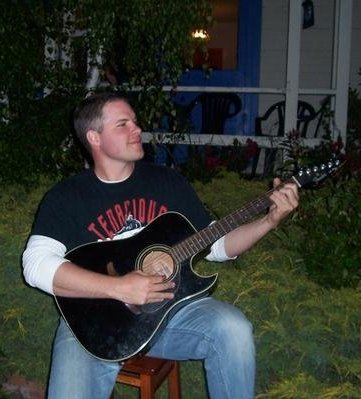
Happily playing guitar badly in my front yard in Santa CruzNext I need to buy some of the supplies that I need to display the collection and to keep the collection going. These are just basic necessities like extra strings, picks, straps, and other general maintenance supplies. I think I can get enough for the first year with around $300. But then I still need to purchase a way to display the guitars and I think that I can get wall mounts (before the discount that I’m going to ask for) for around $20 each so I need about $300 for that. So now I’m up to about $4,350
What I have left over is about $650 that I’m going to use to refresh our music learning collection. I want to purchase books, dvds, cds, magazines, etc… that will help people learn on their new instruments. I should also mention that the starter packs come with an intro to guitar DVD and I think that I will keep that DVD with packs when the patrons check out the guitars.
The last purchase that the library will be making will be the cost of the instructors for the program. I don’t want to take this money out of the grant money because it is an ongoing cost. So I’m planning on paying a guitar instructor about $30 per hour for the group lessons and I have already found some teachers who are willing to do it for that price. Even more exciting, I’ve found some teachers who have offered to do it for free! However, I’m wary of these offers because I’ve my previous experiences with flighty volunteers and I don’t want the students to miss out because the guitar instructor is a flake. So I’m budgeting $480 for two one hour, eight week group lesson sessions. I’ll let you know how that goes.
Fines and Fees
Just so you know, I’m totally against fines and fees. However, we do need to be able to maintain our strings and picks and we do need to repair any damages to our guitars, and I need to ensure that we get these guitars back. So, depending on what kind of price I can get on all of these things, I will be charging some kind of fine/fee structure that is yet to be decided.
While I don’t have the grant approved yet, I am very excited about even the possibility of having a funding source for this collection. If, in the end my grant is not awarded to me, I at least have the foundation for writing more grants! Not matter what happens with the grant, I’m pretty sure I can get this off the ground in a number of ways.
Purchases from The Library Advocate Support Library Advocacy ProjectsShow your support of libraries!Awesome Library GearGreat Staff Gifts!
The Battledecks event at the CLA/CSLA conference in Sacramento was a huge success! Thanks to everyone who came and supported (and hopefully enjoyed) the event, our amazing crew of judges, slidemakers, our gorgeous Vanna White, and of course the competitors. I also wanted to give quick background on Battledecks in libraryland and give some credit where it’s due. First of all, we all need to give a big THANK YOU to Janie Hermann who brought battledecks to library conferences in the first place at Internet Librarian in Monterey. She has been one of the great people that I have had the opportunity to know in librarianship. If you get a chance to meet her, everyone let her know how awesome she is. Also, I want to thank *Tiffany Mair for being so instrumental in helping open the lines of communication between all the folks that made this possible at CLA. The folks at InfoPeople for all of their support, Stacey Aldrich for pushing it forward and making it happen, and Holly Macriss for her overall level of awesome!! I learned a whole lot from this event and next year’s will be better and hopefully bigger!
Anyway…. The real reason you are here. The videos and Slides of Battledecks!
And… the Slides (note, 11 not 10 slides per deck. I forgot that I was sent some extra slides two days before the competition and snuck them in)
Here is a list of things I forgot to do this year that I will do next year… Start planning it earlier, triple and quadruple check the slides, use a high resolution conference logo, have better introductions for the competitors/judges/vanna white, remember to sync my iPhone music to play correct battledecks music by Ed Hermann, include a photo of the Battledecks Trophy in the intro slides, what else would you like to see?
*Tiffany Mair is awesome and graduating with her MLIS soon. She’s a big deal so hire her!
Purchases from The Library Advocate Support Library Advocacy ProjectsShow your support of libraries!Awesome Library GearGreat Staff Gifts!
 I recently came across a job opening in an organization far outside of librarianship. It involved a lot of the things I was passionate about as a kid and am even more passionate about as an adult. This position was for a sailing non-profit organization that takes children out on the San Francisco bay to educate them about sailing, marine sciences, and more. For those of you who don’t know I love sailing, I love teaching, I love working with kids, and I am kind of a fanatic about oceanic conservation. Anyway, talking about my love for this job advertisement is not the point of this post. The point of this post is the following video…
 It’s time for librarians to get out of the echo-chamber of librarianship and get some good words out to the people. So I’m proposing an award (my own personal money) of $250 for the best library-related article to be published in a non-library magazine or journal. Yes, that’s right… My own personal money!! That’s how important this is to me!
 If you want to help us up the ante for prize money let us know by commenting below or sending us a message. Also, any money raised through our Café Press store will go towards added prizes and awards and other library advocacy projects as well so feel free to shop away!


 While writing my


 I read a great article about businesses starting their own libraries of business books in the office and it spurned a thought that I wanted to share with anyone in a community with a large number of businesses. It’s pretty simple and I’m not sure it requires an entire blog post dedicated to it, but I need to write something here anyway and I want to write this idea down before I forget it. Basically the idea is circulating business book bins. (Self-explanatory! That might be all you need to read here. But if you want more, please continue)
 Anyway, I think it would work something like this. The library would put together these various bins and send letters to local businesses advertising this new service listing the various business topics. Each bin would have a collection of books on a specific topic, but only the bin would need to be barcoded because they’re checking out that subject collection in total. There would be a list of materials with a checklist included in the bin to ensure they all get returned. The business would call the library and request a specific topic bin and the library could drop it off. I would love to have the business determine the length of the checkout (which leads to another blog post on check-out lengths later) so they could ensure that they have enough time to have each of their employees read the material. This would be important because businesses of different sizes can have any number of employees and it would take differing amounts of time to circulate the materials throughout the business. At the pre-determined due-date the library would pick up the bin of books. And that’s it. Super easy.
  When I attended the

 The Battledecks event at the CLA/CSLA conference in Sacramento was a huge success! Thanks to everyone who came and supported (and hopefully enjoyed) the event, our amazing crew of judges, slidemakers, our gorgeous Vanna White, and of course the competitors. I also wanted to give quick background on Battledecks in libraryland and give some credit where it’s due. First of all, we all need to give a big THANK YOU to Janie Hermann who brought battledecks to library conferences in the first place at Internet Librarian in Monterey. She has been one of the great people that I have had the opportunity to know in librarianship. If you get a chance to meet her, everyone let her know how awesome she is. Also, I want to thank *


 PC Sweeney