Yet Another #libday4 Blog Post…

I noticed this day in the life of a library thing going around on Twitter and thought I’d take a couple stabs at it and see what happens. However, while I love being a librarian I don’t really think it defines me, nor do I think it defines all of us librarians out here. So I’m going to include my whole day and not just the part where I’m a librarian.

Unlike most folks, Mondays are probably my favorite day of the week. I’m well rested, I don’t have to be at work until noon because I work the late shift on desk, and I get my week all set up. So the day started around 7ish because I completely lack the ability to sleep in (even on weekends, when I feel I should). I typically don’t get out of bed for a while and this morning was no different. Instead I lay around and catch up with all the blog posts from the East Coast librarians, check my Facebook account, scan through some tweets, and finally get out of bed after thinking really hard about writing a blog post of my own.

This morning I went to the gym after not going for the last month which was really nice. I figured out I could read while using the elliptical because there’s a place that holds my book fairly securely. Today I was reading “Cape Horn: The Logical Route” by Bernard Moitessier and this book was blowing my mind (for anyone who doesn’t know, I’m a big sailing fan). I almost didn’t get off the gym equipment because it was so good. I’m not a book reviewer so I won’t try to say much about it except that if you’re a sailor, you should check it out at your local public library.

After the gym I walked back to my apartment reminding myself that I need to cancel my 24 Hour gym membership because this gym is in my apartment. But of course I haven’t done it yet. Instead, I sat around for a couple hours and played guitar a little louder than my neighbors would appreciate I’m sure. I also thought real hard about kicking my roommates cat around (I’m NOT a cat loving librarian) but I decided we can just maintain our uneasy North Korea style truce instead. Besides, he has stayed to his side of the room for most of the morning. But, I KNOW he’s planning some kind of tactical assault and I still don’t trust him.

Anyway, after our stare down I did all of the get ready for work stuff and finally made the drive in to the library where I am the branch manager of a small library in East Palo Alto. Because its Monday, I had a couple of specifically managerial tasks to complete like approving time cards from the last week, signing reimbursement forms, approving trainings, and reading through some of the stuff in the Branch Manual because I’m fairly new to this library system and I’m still learning a lot about everything that goes on here. I also spent a couple hours answering emails, planning the redesign of our staff workroom and coordinating a couple of aspects of that large project. And finally, I did some research for the guitar class program I want to hold here in the summer. Throughout this time I also check Twitter frequently because everyone I follow is a librarian and there are so many librarians doing amazing things and I like live vicariously through them by reading about it in the twiterverse. The other big project for me is that I am running for ALA Councilor this year. So, to make it official, I walked over to the post office and dropped off my petition and submitted the rest of the forms electronically.

What is nice about this job is that my staff speaks Spanish and most of the patrons here speak Spanish too. So I always try to squeeze some time in to study a chapter or two of a Spanish textbook that was dropped off at the library. I also have my headphones on and a Spanish audio book called “Cajas de Carton” playing while I do my work. I always think I’m doing pretty well until someone who really knows how to speak Spanish starts talking to me and I realize I’m not very good at Spanish at all.

So now, I’m spending the last two hours of the evening on the reference desk, answering patron questions (in Spanish when I can), ordering DVDs, using our online Spanish Language tutorial, and straightening up the library shelves whenever they need it. So far… A pretty fun day! And I still get to go home and play some more guitar and listen to some good music with my roommate.


Patrick “PC” Sweeney for ALA Councilor at Large #libday4

On the last day of ALA Midwinter I thought I would check out the Council Session that was going on that morning. As I stood in the back of the room I watched the session and got a much clearer view into the inner-workings of ALA. While there I sent out a couple of tweets regarding decisions that were being made and much to my surprise I got responses back from councilors who were on the floor of the council right then. It was fascinating to interact with the councilors as they sat through the session and made the decisions that would guide our organization. However, I was a little disappointed because it seemed that, while I did get responses from almost a dozen councilors, this was just a very small percentage of the officials in the room and these were the only ones online that day. It seems to me that the organization can open itself up and use some of these new online tools to communicate and respond more freely with the concerns of the members.

So, with the “gentle encouragement” of Aaron Dobbs, who tweeted that I should come over and say hi, I am going to try to run for ALA Council and hopefully add to the voices and open the dialog with ALA members through online resources. I submitted my form electronically and I have sent my petition in the mail. In case anyone else is considering trying their hand at running for council, getting the petition signed is easy (you only need 25 signatures) and filling out the form is completely painless (basically, just a summary of my resume) and you’re on your way. For anyone interested here is what it all looks like. I’d love to hear anyone’s thoughts on running for ALA Council.

Degrees and Certifications:
Sacramento State University, BA Philosophy 2003 San Jose State University, MLIS 2007

ALA Activities:
ALA Emerging Leader 2008
ALA Committee on Professional Ethics: Intern 2010
California Library Association ALA Student Chapter
LLAMA
PLA
LITA

Offices Held in ALA-APA:
ALA Student Chapter: Co-Chair, Web-Coordinator 2006

Honors and Awards:
SJSU Student Association Award for Online Educational Outreach

Accomplishments:
As Library Coordinator of the Twelve Bridges Library I was given the opportunity to assist in the planning and development of the construction of a 40,000 square foot joint-use library (public, high school, community college) and managed the redevelopment of its website.

As a 2008 Emerging Leader I was given the opportunity to work with an outstanding team of new librarians to develop a mentoring plan for RUSA.

As ALA Student Chapter Co-Chair and Web-coordinator I was able to learn manage an organizations website to increase its visibility and value on the web.

As an elementary school librarian I was able to see firsthand the importance of the role of the school librarian and the services that libraries must provide to children and teens.

As manager of a volunteer program of over 250 retiree volunteers I was able to gain an understanding of the need to provide library services to the growing force of retired Americans.

Links:
www.pcsweeney.com
www.twitter.com/pcsweeney

Professional Concerns:
With the emergence of new technologies, growing information access points, and the loss of institutional knowledge through the retirement of large numbers of professionals, the ALA Council must be ready to critically analyze the changing forces of the organization and place ALA in a position to adapt to those changes quickly and efficiently.

As a Library Branch Manager, I have had opportunities to evaluate the change present in my profession. I participated in the construction of a state of the art library and implement programs and services that are reflective of the role of libraries as community resources. I am engaged in learning and evaluating new technologies that patrons are using to adapt their use to library organizations. I have worked with diverse groups of patrons to create services that suit their changing information seeking behavior. And finally, I have managed organizations to increase their visibility and value within communities.

Blogged: Beer and Burgers with John Berry at Bukowski’s in Boston (who says alliteration is dead?)

ALA midwinter brought about many great experiences and I met amazing people who I have admired for a long time. I saw a couple of great presentations, finally met many of the great people that I’ve been following on Twitter, and networked with people who are challenging me to be a better librarian. However, as the post #alamw10 excitement wears off, I’ve been struggling to find something to write about. While many of my experiences were fun and exciting and everyone I met was amazing, one of my favorite experiences was sitting with a man that some people in the profession love and a man that has ruffled more than one feather in the library profession; John N. Berry III

Before the conference I really had no concept of who John Berry was. I definitely knew his name, I’ve read his blog, read some his articles in library journal, and definitely know about him from some of the musings of other librarians, writers, and bloggers who have expressed both love and contempt for the man. But really, I never took the time to see who he was, had no idea what he looked like, why he is such a prominent figure in American libraries or why anyone even knows his name beyond his blog and articles. In any case, I hope you understand how embarrassing this is for me to admit that I didn’t know who he is now that I do know.

So, when I had the opportunity to meet him at the Emerging Leaders Reunion and Social at J.J. Foleys I was a little confused. One of the fantastic people who I had met at previous conferences was talking to an old man at a bar and when I came to say hi I was told, very solemnly, that THIS was John Berry! I was told this as if I should have some idea of who he was. I really had no idea who he was, not putting the blogger/writer (whose name I did know) together with the old man sitting at the bar (who I didn’t know) drinking hard liquor and happily chatting with everyone around him. So I stood there at the bar and patiently half-listened to him talk about whatever it was he was talking about at the time. After a little while he told me I should go to the reception for the Librarian of the Year that was happening the next night. Well, I smiled and nodded and pretended to put the information in my phone and walked away to meet some other of the Emerging Leaders at the social and didn’t really think about it again.

At least until the next day at the Tweet-up for YA and Children’s librarians when I saw him walk by and someone in his entourage turned to see me looking at him and said “Yes! THAT was John Berry!” Again, as if I should really know who this man was and admittedly I should have known by now. But I didn’t know and I was getting pretty curious as to why everyone else in the world seemed to know who he was. Luckily, I had yet another opportunity to meet him.

That night a few of the people I knew at the conference told me that they were going to the Librarian of the Year social and since I had heard about it from so many other people at this point, I thought that I might as well go. Because so many people had told me about it, I was surprised by the low number of librarians present. It turns out that this was a fairly exclusive party and in all honesty I really had no business being there at all. In fact, one of the people at the party made it a point to figure out why I was there, and when I could produce no real reason she glared at me as if I had just crashed a reception at the white house. So I stood, off to the side, trying very hard not to get kicked out, and there was Mr. Berry talking to >Josh Hadro who is the associate editor of Library Journal and Nate Hill who runs the blog for PLA (who I name here because I feel I should thank them specifically for this opportunity). Luckily, before I could really embarrass myself these two good folks filled me in as to who exactly I was talking to and finally everything made sense, except for why I hadn’t put together who this man was before I started talking to him.

As the night progressed I had the immense opportunity to really meet John Berry. We talked about my thoughts on Library 101, who should be asked to write for Library Journal (as if I have any idea at all), who we all thought the Annoyed Librarian might be, and generally what we all thought of the profession as a whole. He challenged my opinions, joked and poked fun (in a good way) at my inexperience in librarianship, said some things that I know where just said to ruffle some feathers and make the conversation interesting, and throughout the entire time he was more than an interesting person. So when we had the opportunity to move the conversation and eat burgers and drink beers at a dark hole in the wall called Bukowski’s (thanks entirely to Nate) I jumped at the chance. And, for the next two hours I sat transfixed by stories and opinions about everything from librarianship and politics to Allen Ginsburg, Malcolm X, and so many others that I lost count or reference. I’m not going to pretend I can remember or retell any of the stories he told us that night and I’m ashamed to admit that I don’t remember every word he said but he was wealth of institutional knowledge and it was a night of live oral history as I’ve never experienced.

So, while you may have your own (good or bad) opinions of the man from his blog posts and articles I encourage you to take the time to meet him (buy him a drink) and listen to the story of librarianship as told by John Berry. I just hope someone takes the time to write a book about this historical archive of our profession.

The Unabashed Fervor Surrounding #alamw10

The unabashed mounting fervor surrounding ALA midwinter is about to crash down on Boston like an Avalanche. I’m not going to lie, I’m one of the conference fanboys, but I feel like this conference is already off to a kind of insane beginning. As I’m watching the twitter feed it seems to be exploding with just about every kind of activity that makes these overly large conferences such a good time. I’m going to share with you some of this craziness in case you’re missing it.

1) Librarian Tattoos
Inspired by Andy Woodworth’s campaign for a Ben And Jerry’s Library Flavored Ice Cream, there has been a call for all librarians to get tattoos at ALAMW. Or, as the creator of this campaign (Justin Hoenke also from 8bitlibrary.com) has called the campaign – “Project Brand Yourself.” Yes, this is as crazy as it seems. Librarians are going to descend on Boston area Tattoo parlors and get branded with the library logo. Now, I’m a big library fan and I would love to just go and watch librarians get branded with the library logo, and I even want a tattoo, but I’m not sure this is going to be my first. If you get one, let me know when and where so I can watch or at least post a photo. I support this project and support everyone who gets a tattoo. Go get’em!

2) The Socials
By following the twitter hashtag #alamw10 I’ve decided that librarians drink the highest amount of alcohol per capita vs. just about any other profession anywhere. Don’t believe me? Just take a look at the socials and happy hour events going on at ala. It’s going to be hard on my liver.

  • LITA Happy Hour
    YALSA Happy Hour
    GODORT Happy Hour
    ALA Emerging Leaders Meetup
    ALAMW Tweetup for Newbies
    ALA After Hours Social
    LibraryThing Party
  • 3) The Twitter Feed itself
    Already, the hashtag #alamw10 is on fire with content and information. I’m excited to see how this plays out over the course of the conference. It’s possible, that like #CLA09, the feed will die out once the conference begins but with the number of power tweeters attending this conference I’m not sure that will be the case. If you’re new to Twitter or just need some good folks to follow for this conference, I’d like to recommend a couple to you (there are far too many to list them all, these are just a few);

    @libraryfuture
    @griffey
    @JustinLibrarian
    @theanalogdivide
    @oodja
    @gcaserotti
    @pollyalida
    @itsjustkate
    @vonburkhardt
    @JanieH
    @TiffanyE
    @buffyjhamilton

    And of course the Official Tweet of ALA Midwinter
    @alamw

    4) Bloggers
    With the high number of power tweeters comes a high volume of power bloggers. What’s nice about these folks is that they almost all have a Twitter account and you can find them via the conference hashtag. One exception, of course, is Annoyed Librarian, but nobody likes her anyway. But, in case you’re not a twitterer I’ll give you some of my favorite bloggers just in case. Here they are (in no particular order);

    http://www.8bitlibrary.com/
    http://lyndamk.com/
    http://libraryman.com/
    http://agnosticmaybe.wordpress.com/
    http://www.jasongriffey.net/wp/
    http://theshiftedlibrarian.com/
    http://ashuping.net/media.html/
    http://www.theanalogdivide.com/
    http://hoodandhat.blogspot.com/
    http://theunquietlibrarian.wordpress.com/

    5) The Conference
    Of course, let’s not forget the reason we are all here in the first place. This conference is huge. Perhaps this conference is not as big as ALA annual but it is still very large. ALA reports an average attendance of 11-12 thousand librarians. While this conference is mostly a business meeting, there will be some really great institutes, meetings, discussion groups, and other events covering everything from web 2.0 to such staples as Library Management. With so much going on it’s hard to decide what to do first. But everything you need to plan your ALA conference is available online via Twitter, Facebook events, Organization Blogs and websites, and at ala.org through their event planner, and ALA Connect. Take some time and check them out.

    6) ALA Secrets…
    For those of you who want to know what really happens at ALA midwinter, or those of you with secrets to share I’d like to introduce you to alasecrets.com. You can submit you own secrets, trysts, misdeeds, and misfortunes at the conference anonymously for the rest of us to live vicariously through. This twitterfeed is absolutely entertaining and so are many librarian’s reactions to it! I love that it causes such a stir that it was hacked and brought down at the last conference. I hope that everyone can be cool and have a good time checking out what’s really up with librarians (even if we’re lying about it).

    Have fun team!

    Leadership is Just Like Beating Schoolchildren with Bags Full Of Kittens #library

    Why is every seminar on management always called “A New Approach to Leadership?” Just once I’d love these “consultants” to be honest and call it “The Same Thing you Heard Last Time You Were Here, but We Repackaged It and Now You’re Buying the Same Thing you Bought Last Time for More Money. Thanks, I Can Now Pay for My Kids New Porsche.” Ok, well, I guess the reason that they don’t call it that is because it’s just too long. No, I’m kidding, the reason they don’t call it that is because they buy their kids Maseratis not Porsches because we pay way too much for consultants. Anyway, the point I’m trying to make here is that every seminar is exactly the same and nobody really seems to know what leadership and management is all about.

    In case you don’t believe me, I been to far too many of these seminars and workshops and I’ve read a far too many books on the subject. So, through all of this, here is what I’ve learned so far;

    Management is a circus
    Leadership is like a captain of a ship
    Leadership is like being a firefighter
    Leadership is like the conductor of an orchestra
    Management is a game of baseball
    Leadership is like being president (specifically, Lincoln)
    Management is like being Ben Franklin
    Leadership is like being an architect
    Leadership is an art
    Leadership is like a tribe

    Apparently, there are rules too…
    There are 101 rules of management
    There are 13 irrefutable rules to management you can’t break
    There are 12 rules of management
    There are 7 rules of management
    There is only one rule of management
    Break all the rules in Management

    (Of course, if you don’t believe that each of these exist, I suggest you look’em up on Amazon. I’m not kidding, each of these are there)

    However, this whole rant started because I recently went to another leadership seminar because, despite all of this, I still absolutely love going to these seminars. Just like all the previous seminars I’ve been to, this one found another way to relate leadership and management to yet another profession that’s slightly related to management and leadership and still far enough removed that you wouldn’t think of it as a profession related to leadership and management. Which I think is what these seminars are really supposed to do. That is, find two unseemingly related professions and then point out exactly why they are the same or define some aspect of a profession in terms of a set of rules and then encourage you not to follow those rules.

    That is, of course, not to say that this one wasn’t especially informative because I learned two very important pieces of information. The first thing that I learned is that I could definitely write a book on leadership and management if only there was one profession left that hadn’t been related to leadership and management. Which is good if I find one, because the second thing I figured out is that they let any idiot write a book on leadership and management. I could be that next great idiot! So, I’m going to start working on this, because I’m pretty sure that being either a leader or a manager is just like beating school children with bags full of kittens. In any case, the title of this book will be “Leadership and Management is Just Like Leadership and Management. Now Don’t It Screw Up.” I’m excited to see you at my next seminar!

    Friday Favorites: My Favorite #library Tweets from 12/07/09-12/11/09

    As I’ve been perusing the twitter feed for the hastag #library, I’ve noticed that there are some great ideas on here and I want to collect as many of them as possible. It just reminds how many librarians there are out there who are much smarter than me. These folks are doing some great work and showcasing a lot of it on their twitter feeds so I thought I’d like to share some of my favorites from this past week. There were a whole lot of other great posts out there besides the ones marked with the #library hashtag but I limited it because this post would be far too long had I not set some kind of limitation on it. Some of these posts are funny, some are informative, and some have links to even more information if you’re interested. If people like this, I’ll try to do it every Friday!

    @Renato71: They’re building the new library here in #helmond http://twitpic.com/t24tg
    I love new about new libraries being built! It seems like Library Journal is filled with a lot of doom and gloom news about libraries closing right now and posts like this make me happy

    @Jason_Scroggins: The Library Study at Fresno State: http://bit.ly/4XIRfp
    This is a very complete study on library spaces and usage at Fresno State via a design anthropological perspective. This study is so complete, in fact, that it is longer than 140 characters and thus I haven’t read it, but I’m thinking really hard about reading it.

    @interactiver Thanks for the nifty craft ideas! http://www.onehourcraft.com/?p=168
    There are some great one-hour craft ideas that are a boon to library programs available here. They are cheap and easy, just the way we like’em!

    @wawoodworth: Blogged: The search for the next big thing, ctd. http://bit.ly/8Y9yGu
    Yet another great post from the Agnosticmaybe.wordpress.com blog. If you’re not reading it…

    @dmguion: How to take the fullest advantage of resources http://bit.ly/7qef2R
    This is a great blog post that would be more suitable for our patrons to read than us librarians. If you’re in a position to get this post out to your public, then I think it should be done. There is a lot of good information here about the ways that your patrons can take advantage (in a good way) of your library.

    @tamahoc: excited about the soon-to-come new city centre http://bit.ly/7rst9r
    Excellent information the economic value of a new library in a community and what that library will bring its residence in $$$. Most of the information comes from the Urban Institute. (not to be confused with the Urban Libraries Council)

    @tamahoc: rethinking the restroom question at the http://bit.ly/70WQMl
    I just always a big kick out of debates that are going on in the reference sector of librarianship. RUSA always makes me smile and giggle a little

    @brothadave202: oh shit..my battery bout to die..time to hit up da Library
    Way to use the library brothadave! Thanks for stopping by, even if it’s just to charge your batteries. While you’re here, by the way, we also have books! Just FYI…

    @justhvk : Should you become a librarian? http://justhdoit.freeblog.hu/archives/2009/12/07/Should_you_become_a_librarian/
    SUPER FUNNY flowcharts always make for a better day!

    @CoffeeTimeRoman: Every librarian needs to see this: How libraries can adapt to changing users & environments http://bit.ly/5DRB6o
    This is a good slideshow, some good thoughts

    @tiffanye Top 5 library commercials on youtube: http://bit.ly/5YrdTs // Number 2 is my fave! Which is yours?
    Oh good, more ways to waste time on Youtube! I’ll always oblige. There are some good ones.

    @cougarlibrarian: The balls on our library Christmas tree are big and unbreakable. Just like the balls of our #library staff.
    HAHAHAHA!!! ‘nuff said…

    Mountain View Public Library’s Automated System Actually Works! (I’m surprised too) #library

    Materials Sorting Maching
    Materials Sorting Maching
    As the second part to my post (or rant) about automation in libraries, I want to write about why I think Mountain View Public Library’s system might change my mind. MVPL uses the Libramation system for their RFID and MK for the sorting system & return software and circulate roughly 1.5 millions items out of just this one library. If you are unsure about why I dislike automated systems so much you can read my previous post. Some of this might not make sense unless you read that. Also, I want to talk about the library itself and some of the features I saw that I really loved, but I think that will have to wait for yet another post. So I’ll stick with the automation and how it addressed my concerns for this entry.

    COST
    I’m not sure what it cost them (I was afraid to ask) but I was doing a little math in my head as we went through it. The costs seemed to be- the sorting machine itself, book drop interfaces, RFIDs, self-check, RFID printers, construction/installation, staff training, and ongoing power, supplies, and support/maintenance costs. These are the costs that I would expect and nothing out of the ordinary and the savings typically come from the reduction in staff which was my second concern.

    STAFFING
    Our tour guide was the Circulation supervisor and she explained that this system did bring in a large reduction in staff time. I was unable to see the savings in action this day because we were on the tour the day after a holiday and more staff were called in for all the extra returns, but typically I was told that there was only one person in the back room managing the system with occasional pages to do the detail sorting and shelving. Also, I noticed that because they also had Self-check stations the front desk was only staffed by one person. So, from what I could tell, for a circulation of 1.5 million and only needing one paraprofessional in back, one on desk, and a handful of pages shows a fairly significant savings over the long run. This reduction in staff was mostly because the system actually works! Which is was my third concern.

    THE SYSTEM WORKS!
    As we were in the processing room with the machine we got to see it working first hand. To my great surprise, the machine actually worked! The books were dropped in the book drop, instantaneously taken off the patron’s record and taken on a conveyor belt were it was rough sorted into 11 different categories depending on where it belonged in the library. For example, one cart was for books in the adult non-fiction area from 0-100, the next for 200-300,

    Self-Check Stations
    Self-Check Stations
    etc… and holds or problems when into the last bin. The carts were then hand sorted by pages to carts and shelved. The only real glitches had to do with items being returned that didn’t belong to MVPL (which is a glitch at almost any library) and items that couldn’t be RFIDed properly because of its shape or case. This second problem was being corrected in a number of ways and won’t be a problem any more in a couple of years. The first glitch has to do with patrons using the system which was my largest concern.

    THE PATRONS

    Book Drop Interface
    Book Drop Interface
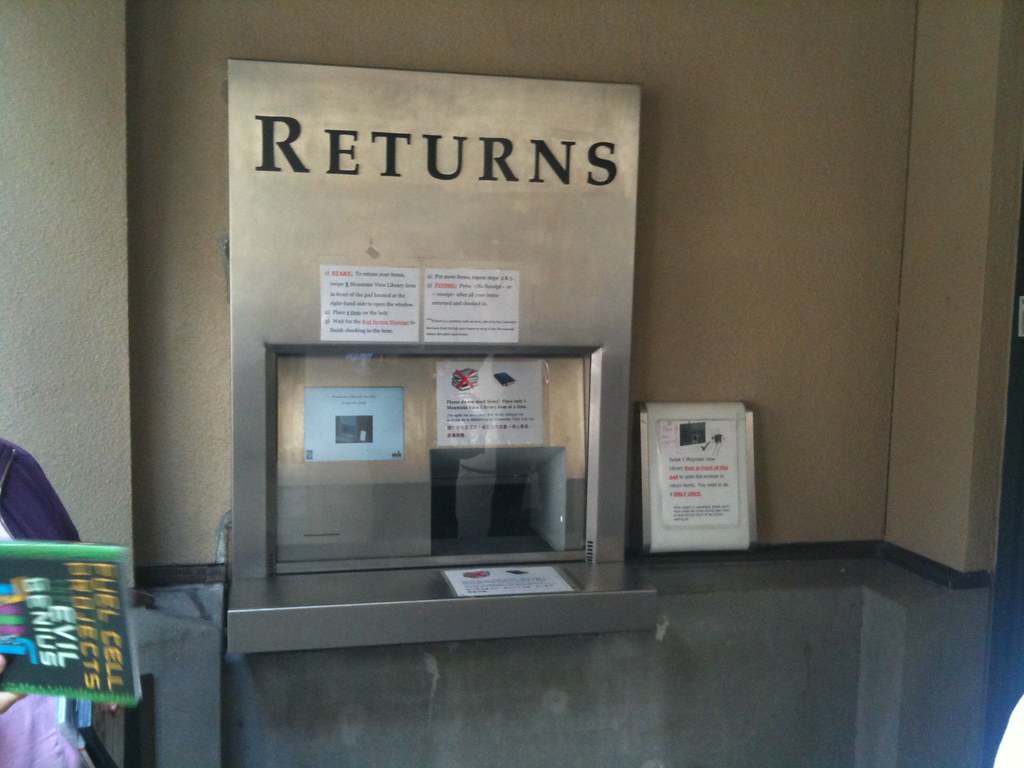
    I took a little time and watched the patrons interacting with the machines. It seemed to go smoothly but I could tell that there was a large learning curve for them by the number of signs on the book drop. I suppose this is to be expected since the new system requires a new set of rules that they had to learn. For example, the patrons had to place items one at a time on the conveyor belt for the system to work properly and a light in front made it seem that it was scanning a barcode and not a RFID. Also, a piece of drop down glass covered the machine to keep people from placing things that didn’t belong into the drop. However, when I first arrived and looked at the machine, my first thought was that it was closed and that I couldn’t use it. After a couple of minutes of investigation a patron approached and opened the glass by scanning a book on the outside RFID reader and returned her books very easily. Even with these little issues, everyone I saw that day (especially the kids) who used the self-check and the return interfaces seemed pretty happy with it all. And happy patrons + happy staff = a win in my book!

    So have I had my faith redeemed in RFID and Automated Materials Handling? Maybe… However, I still think that these systems require a lot more work than the vendors tell you they do, not all of them work as well as MVPL’s, and I would be concerned that libraries who use these systems with significantly smaller circulation numbers won’t see the savings that the systems could bring. So I still recommend a fairly high level of caution when thinking about adding one of these machines to a library. Its shiny, its new, it doesn’t always work, but for MVPL, and our library system’s installation of the same system, I’d say we are very potentially making a great decision and definitely making a good well-researched decision. Way to go team!

    Why I HATE RFID and Automation and How Mountain View Library Might Change my Mind #library

    Mountain View Public Library
    Mountain View Public Library
    I’m always a little skeptical of automated library return systems. I’ve had some bad experiences with them and I’m never sure that they have a positive return on investment. So when our library system decided to invest in four at four of our branch locations I was a little worried to say the least. Luckily, our director made the decision to have our branch manager meetings at other libraries in the area instead of within our own library system. This lets all of us branch managers gain a little insight into the tools and techniques of other libraries and in this case, gain a more in depth look at the automated system in the Mountain View Public Library (I will review this automated system and this beautiful library in general in a post to come). This re-look at these kinds of systems made me think of my own personal history and concerns about automation and RFIDs in general.

    The first concern is the cost of such a system. In my last library we used the 3M system for RFIDs and automation. The RFIDs cost $0.46 each (we had 180,000), the RFID readers cost a few thousand each (we had almost 20), the RFID printers were rented and still cost a few thousand. These costs don’t include the costs for the servers, wiring, installation, security gates, self check-stations, and software maintenance charges that total some number beyond my comprehension. At that library we didn’t have, and therefore I didn’t include the cost of a fully automated sorting system and all items fell through the bookslot and into one bin.

    The second concern is that, in my experience, these systems don’t require less work from staff at all. We were told that, as the items fell through the bookslot, they would automatically be checked-in and all we would have to do is sort the items and put them back on the shelves. However, this was not case. Items in the bookdrops were only checked-in 60-65% of the time requiring all items to be re-checked manually and sorted for holds and ILLs by hand. Also, metallic items such as anything with a CD, or metallic and reflective paint would not be scannable with the RFID system. Our library system also had a second building that wasn’t RFIDed. This is a similar problem found in library consortiums where items can be returned between library systems and different brands of barcodes or RFIDs are used that aren’t compatible. In relation to the amount of work required by automated systems is how much work staff is still required to do. Generally, the items still need to be pulled that are on hold or ILL, they still need to be

    My third concern is; how well does the sorting machine actually work? I’ve been to a few libraries that use an automated sorting system that simply doesn’t sort the items in a way that’s even remotely effective. The items are misfed, mislabeled, and missorted to such an extent that the librarians have simply stopped using the system. The complaints from the poor folks who are stuck with these machines are long and plentiful and filled with stories of what could have been better done with the hundreds of thousands of dollars that were spent on the non-functioning machine. Of course the vendors promised the world to these sad librarians and I’ve actually heard the vendors say at conferences that staff will never have to touch a book again! In fact, I’ve had to stop spending time in exhibit halls at conferences because I’ve angered too many venders by my questions that lead them to admit to the Music Man like lie they just blatantly made to the group of librarians who surrounded their shiny new machines that would solve every library problem ever created and sure to come.
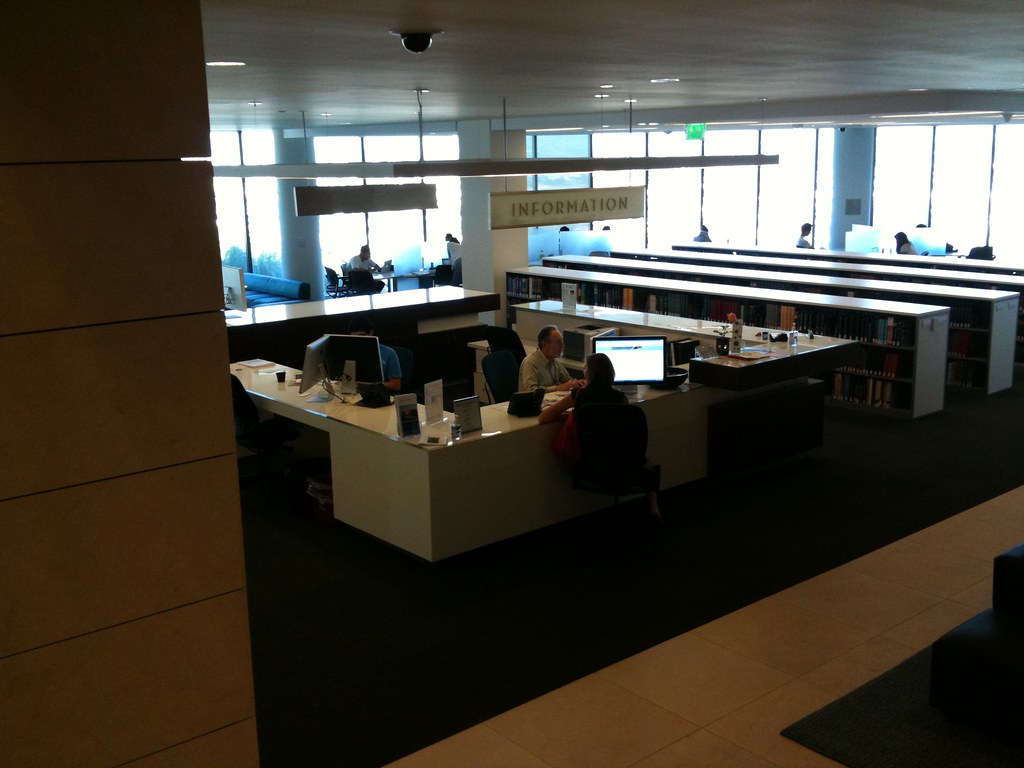
    My final concern surrounds the ease of use for the patrons who are forced to use this machine. As the librarians are already frustrated with many of these systems, the patrons forced to use them oftentimes have the same experience. Many times the system has a new set of rules that patrons must learn, the system doesn’t work intuitively or consistently, and the end result is that the patron makes a mistake, the machine doesn’t work and the patron gets blamed, feels stupid, or simply doesn’t want to learn. And honestly, who can blame them? They already have to learn how to use ATMs, different self-check systems at grocery stores, smartphones, computer programs, different computer platforms, and the list goes on.

    As a side story – I was recently talking to a library director at a conference about their RFID system and she made the comment that items need to be returned one at a time through the bookdrop for it to work but patrons were putting in more. Someone asked how they make sure that items are put one at a time through the bookdrop and she simply said “oh, we made a sign.” I asked her how that worked out for her, and she said…(I’m not kidding)… “it’s a really nice sign that’s made out of brass and engraved” and then looked at me as if that settled the problem and answered my question. I’m not sure that it did, but I gained a lot of insight into how that library works with that statement.

    Luckily, I found that the Mountain View Library’s system solves almost all of these problems and is, as a library building, a very beautiful and functional space. Perhaps, one day renewing my faith in library vendors and automated systems. I will be blogging about how this whole thing SUCCESSFULLY!!! works in the days to come.

    My tour of Loyola Marymount University’s #library

    Outside of LMU library
    Outside of LMU library
    After CLA in Pasadena I was invited by Carmen Mitchell who I had met at Internet Librarian the week before to take a tour of the new Library at Loyola Marymount University. This is a gorgeous academic library on the campus of a private Catholic college. However, because it’s a new library and has only been open a few short months (in fact, this the first semester) there are a number of the typical new building issues that I’ve experienced and that I’ve heard from other librarians who have had the opportunity to build a whole new library. I’m going to pass over these issues and focus on a few of the great aspects of the library space.

    Information Screens
    Information Screen
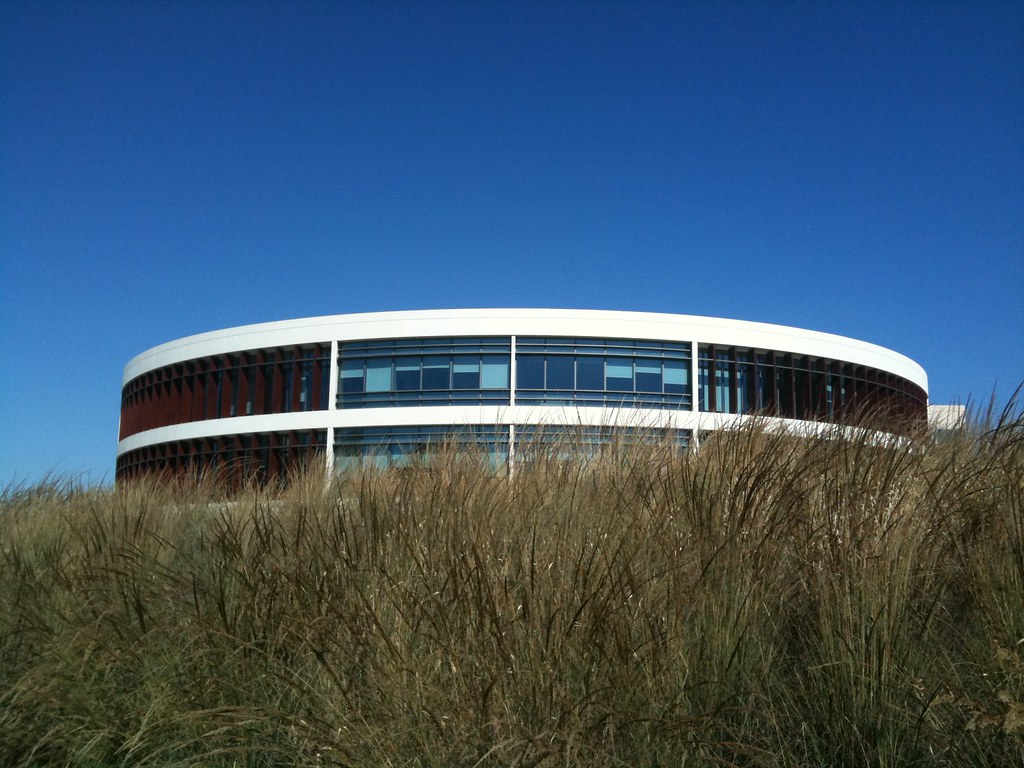
    The building itself is an amazing piece of architecture. Built in the shape of a circle, it defies the stereotypical library building focus of straight lines, columns, and rows that I see both inside and outside of libraries. Immediately, it is set apart from many of the other boxy academic buildings surrounding it. The entrance is wide and allows for a great decompression zone that separates the library and creates a defined boundary from the outside world. The design of the building is actually an outside circle surrounding an inner square that contains many of the working features of the library. Within the square are the offices, storage spaces, and working areas of the library and around the outside they’ve create a “Living Edge” with seating and study rooms. In between these two spaces are the books and materials for circulation.

    There isn’t much to say about the materials in the library and the way in which they are organized as I felt it was fairly standard. Nor were the staff spaces (with one exception, that I will explain later) out of the ordinary. However, I was very interested in the working spaces for the students that they had created, what worked, what didn’t, and how the students adapted.

    Reference Desk with two screens
    Reference Desk with two screens
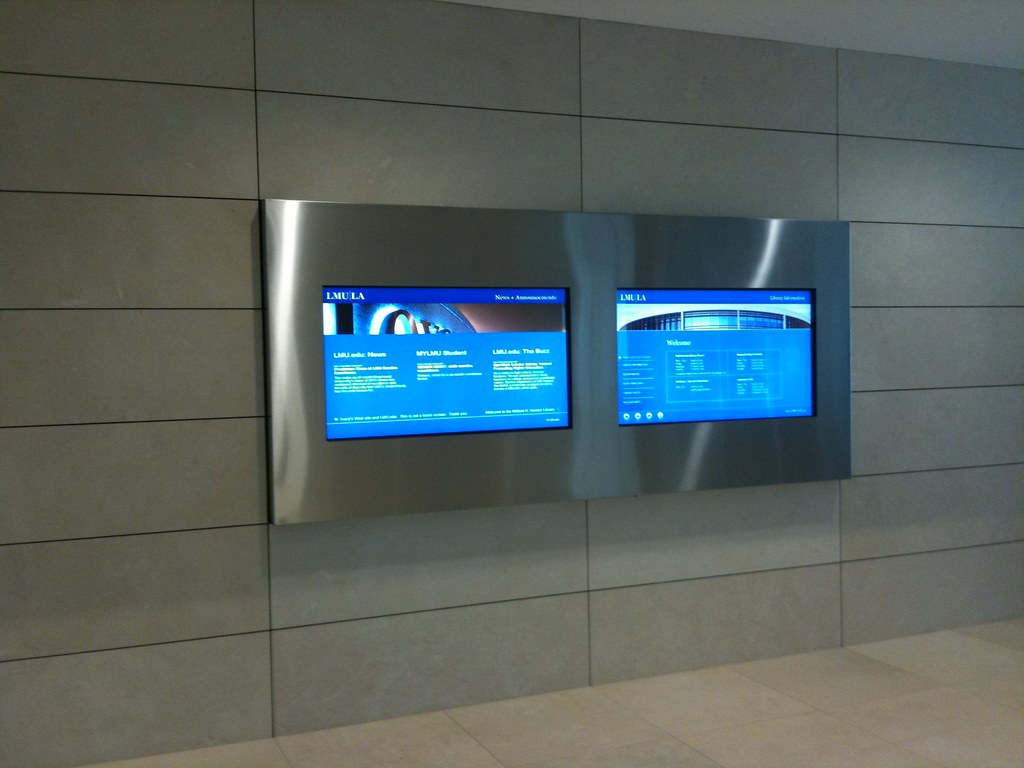
    As I walked through the library with my tour guide I noticed that the library using the Mac platform almost exclusively. These computers also had Windows loaded on them but every computer was a Mac. Each of the computer stations used large flat screens at angles that appeared to lend themselves for students to work in pairs if need be. In fact, at the reference desk there were two computer screens that allowed the student asking the reference question to see what was being done at the reference librarian’s computer without having to share on screen and turn it back and forth.

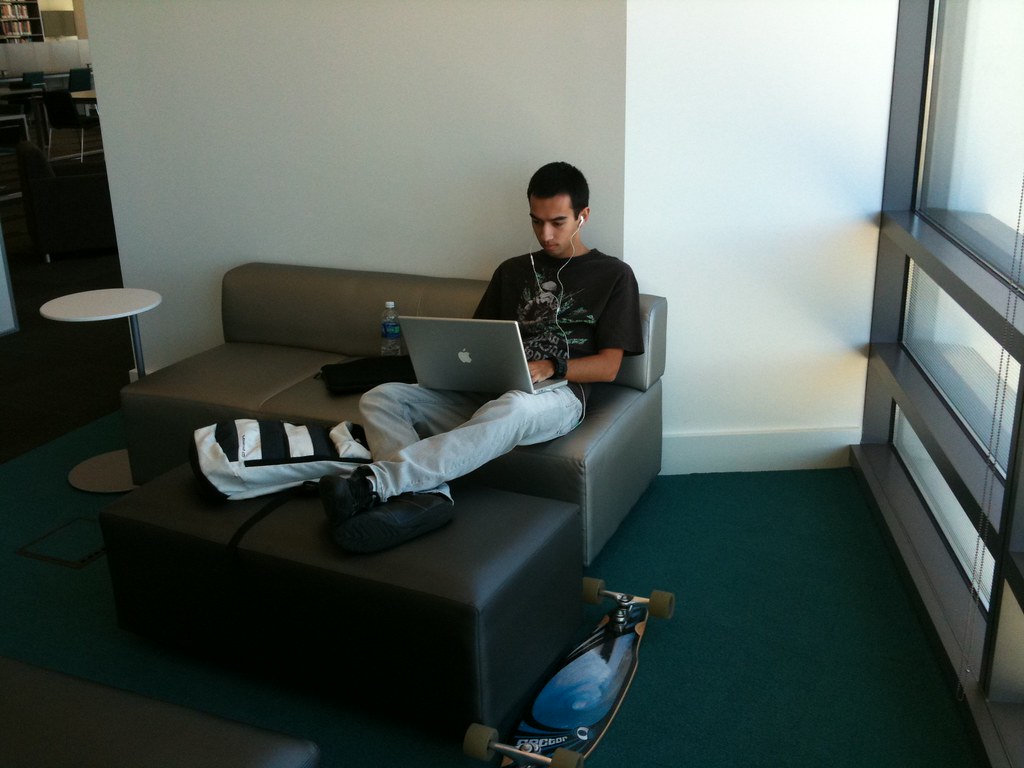
    The large table workstations and study carrels themselves were one of my very few complaints. The tables lacked any data and power ports and students who were using their own laptops or other technology were unable to plug those tools into the space that they were working in without an excessive amount of effort. The study carrels were small and didn’t allow for students with multiple books, laptops, and notebooks that many students are using for class work. I didn’t notice very many students using these spaces, but did notice the way that the students had adapted to the spaces and created some of their own workspaces as in the photos below.

    Student at work
    Student at work
    Student at Work
    Student at Work


    My favorite feature of the library was the study rooms that were built around the edge of the second floor. These spaces were enclosed, with a table and four chairs designed for group work and students could reserve the rooms

    Study room with whiteboard walls
    Study Room with Whiteboard walls
    online or at kiosks in the library. Also, in these spaces were flat screen TVs that students could use to view many of the various forms of multimedia that is available to them. The walls of the rooms were completely made from a surface that was designed for use with whiteboard (dry erase) markers. These kinds of features seemed to lend themselves for more interactive and collaborative work without being restricted to the size of a standard white board.

    My other favorite feature of the library was a staff or faculty workspace. This area contained many of the latest and most advanced research technologies with some of the older technologies blended seamlessly together. The entirety of the walls was coated in the same dry erase material that the student study room walls were made from. There were also a number of projectors and interactive equipment that encourages collaborative work in the space.

    Overall I was very impressed with the building. Aside from the few complaints here and there that seem to stem from the construction of new buildings and the uneducated faculty and deans about the uses of libraries in the new millennium I feel that the library is a successful addition to the college campus and has potential to lend itself to many of the changes in the ways that people and students or faculty use libraries that are coming in the next 10-20 years at least.

    Top 8 Tweets from #cla09 #library

    All-time 8 best tweets from the California Library Association #CLA09

    The CLA conference was an interesting weekend of technology deficiency and lackluster participation from both the venders and presenters. Unfortunately there was a sadly insignificant amount of tweeting going on and this is probably due mostly to the fact that there was no Wireless Internet available anywhere in the workshops. However, a HUGE thank you must go out to @strategicimp for providing the one wireless area at the conference and for providing (in my opinion) the best part of the conference, which was actually the Unconference.

    I won’t go into too many details, but truly, I’m not sure what I would have done had that area not been set up. There were a couple of good discussions and quite a few great librarians (and librarians to be) hanging around the unconference “stealing” the internet and networking with each other. I hope they continue this event next year and get even more participants.

    Although the tweets were few and far between I did manage to find a couple that I thought had some significance. The following are (in my opinion) the top eight tweets from #CLA09 and most came from the movers and shakers presentation that I had to miss.

    @derekwolfgram “sometime you just gotta do stuff, and it pisses people off” -Lisa R

    @joycenlee Think about how to leverage your past experiences. Just b/c they’re not directly related doesn’t mean they’re not relevant.

    @jdscott50 “Gain a broad perspective of the organization, own your job, your role, be accountable, create mentor relationships.”

    @tiffanylora “Leaders motivate others to create their own vision and together we can affect change.” ~Cindy Mediavilla

    @sudofonik Think and be positive; don’t assume you won’t get an interview. There might only be a handful of applicants

    @kgould “policy is the history of bad behavior” (the Unshelved guys)

    @strategicimp focus on the experience u want to create – them design services and environment to make them real. ABA !

    @bibliotechnical: Step 1 for digital collection make friends with political figures in community

    There were some other good ones, but there were some even better tweeples present at CLA. While I couldn’t list great tweets from every single one of them I did want to mention that the following listing of librarians on Twitter are awesome people for twittering about the conference and being cool! I was just going to make a list on Twitter, but that feature needs some work and you should probably just follow these kickass folks anyway so….

    @Ddegrandchamp
    @Frances_J
    @leshaner
    @amapolaroja
    @SofiaDistracted
    @tiffanylora
    @derekwolfgram
    @sudofonik
    @msmith003
    @SusieOhQuinn
    @kgould
    @GraceMellmanLib
    @saclawlibrarian
    @shanndev
    @patoney
    @CaliMel
    @unpoete
    @RubySlppers
    @lifeinoleg
    @maromatic
    @gdhansen
    @friedicecream
    @julianyoko
    @kbuxton
    @KiyomiD
    @joycenlee
    @judybatt
    @alli_librarian
    @hbdanielle
    @Zorrah
    @HeyDiggy

    And if I left you out of my CLA tweeples list, it was a mistake. Let me know that you were there and tweeting and I’ll add you in! Good times team 🙂