My OTHER Super Fun Project!! The Story Sailboat

In case you don’t know, my other passion besides libraries is sailing. As part of that passion I’ve always wanted to get paid for it like I do for libraries. Isn’t it fantastic to get paid for what you love doing? Anyway, in order to make that happen I need to get my Captain’s license and have a business to do my captaining from. So, about 4 years ago Joey Elle and I put together the beginnings of a non-profit. Unfortunately, life got in the way and I didn’t have access to a lot of the resources I needed to finalize it. Well, it looks like I almost do now! So I started it back up again with some changes thanks in large part to a lot of brainstorming with Andrea Davis.

This non-library (but still kinda librarianish) sailing project is being blogged about on its own website but I thought I’d re-post this introductory one here in case anyone is interested in following that blog and our sailing adventures. It’s called the Story Sailboat.

The Story Sailboat is an epic project to travel the world by sailboat collecting the stories of coastal people and relaying them to the world while providing literacy training to the local people. This project is being put together by Patrick Sweeney (PC Sweeney) and Joey Lehnhard (Joey Elle). You can follow Patrick and Jo on various Social Media if you want to see what else we’re doing in life besides just this but let me tell you a little more about the two of us

Joey Elle
Joey is a teacher in East Palo Alto at the 49ers Academy where she teaches seventh and eight grade math and science. For two years before taking her job in EPA she was working as a Peace Corps Volunteer in the country of Lesotho (South Africa) as a primary teacher trainer. She also worked with African Library Project to establish libraries throughout the country. She has her undergraduate degree in molecular genetics and her masters in education.

Patrick Sweeney
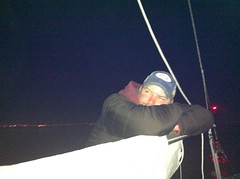
Patrick works for San Mateo County Library and manages the East Palo Alto and Portola Valley Libraries. He has worked in libraries since 2005. He is also a councilor for the American Library Association, writes a library blog at http://www.pcsweeney.com, and is involved in a far too many library-related projects. He goes by the name pcsweeney online and just about all of his work can be found by Googling that name. He has a masters degree in library and information science and an undergraduate degree in philosophy. He is working towards getting his USCG captain’s license this year.

Our Boats
We live on a Columbia 34 named Surprise Me Too in Redwood city that we are rebuilding and preparing for some sailing. While this will probably not be our final boat, we are learning as much as we can about what we need to know about the maintenance and repair of a boat on it. It’s also the cheapest way to live in the Bay Area.

We sail a Santana 22 called Sailboat Jerry (named after Patrick’s favorite rum). This boat is strong, in great shape, and ready to take us all over the bay area. Patrick purchased it from Spinnaker sailing and it was one of their school fleet of boats meaning it has been well taken care over the years. If you learned to sail from Spinnaker Sailing then you might have sailed our boat!

Patrick used to live on Coronado 27 that was called Surprise Me (hence, the naming of the Columbia to Surprise Me Too). That boat took him and his friends on many adventures around the bay and was his first serious bay boat. It was traded for the Columbia because the owner of the Columbia wanted a smaller boat.

Before that, Patrick and Jo owned and sailed a string of various small sailing dinghies ranging from Snark (made by Cool) to a wonderfully fun Lido 14. We’ve also sailed a wide range of larger boats all over California.


The Journey Begins

We have a long way to go and many different things we need to do before we are actually ready to set sail for good on this journey. So, this blog is going to be about everything we have to do to get ready to go. We are going to review the boats we are sailing, document the work we put into our boats, the resources we use to get Patrick his Captain’s License, the sailing equipment we learn about, our trial runs at collecting great stories, and also our sailing adventures as they happen. There is so much to do and we’d love to take you on our journey with us so follow us here or on Facebook!

LibraryLab – Library Boing Boing is up and Running!

ALA Happy Mutants Rejoice! Library Boing Boing is here with its inaugural post! This is something that I’m very excited about, but haven’t had a chance to be as involved in as I originally would have liked (sorry Jenny and Jason). Basically, the amazing and wonderful Jenny Levine from ALA put together an opportunity to post to the great website boingboing.net using the name Librarylab. The content will be based around libraries and exposing all of the amazing things that libraries do for people on a non-library based forum (which you know I support).

Proposed Mission:
To bring librarians and Boing Boing readers (aka, Happy Mutants) together to generate support for and raise interest in libraries via projects at local libraries.

Proposed Goals:
• Help find and propose content about libraries that could be posted to Boing Boing.

• Provide active ways for Happy Mutants to support and get involved with their local libraries (eg, toolkits, best practices, ideas for local projects).

• Create dynamic programming at library conferences that Library Boing Boingers can then take outside of the library community to promote libraries (eg, SxSW, local community events, etc.).

• Work together to help Happy Mutants advance our shared interests (eg, copyright reform, net neutrality, game culture, digital divide issues, open government, etc.).

• Coordinate an international community of librarians working with their own Happy Mutant groups.

It’s being organized though the ALA Connect medium and you can join the backchannel discussion there. Jason Griffey and Jenny did an amazing job getting the folks together who did all of the background work and laid the foundation. But now, it’s time to get content and that’s where you come in! We’d love to hear what kinds of things your excited about in libraries that you think the world should know about. Have a great maker story from the library? A new library technology or innovation that you think the Happy Mutants would love to hear about? A thought on how folks can connect to the library in a new ways that people should know about? Tell us about something you think should be up on Boing Boing and see it up on the blog!

This Facebook Ad Campaign Might Save Your School Library

John Chrastka is a BOSS! This is a guest post from him about his campaign to get signatures on the White House Petition on School Libraries

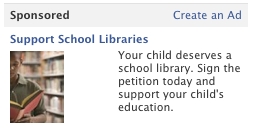
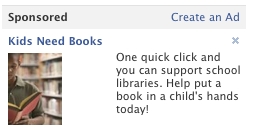
On Wednesday, January 25th, a call went out for donations to help support a targeted advertisement via Facebook in support of the White House Petition on School Libraries. Quick creative, keywords, and copy were built about the petition and fielded to an initial audience of 3.8 million people. By 10pm that evening, 34 individual donors pledged $1,250 in support of this outreach. The initial ad targeted Facebook users people who have keywords on their profiles indicating that they were supporters of libraries, reading, and books, or were professionally involved in the library field. From 2pm CST on 1/25 through 2pm CST on 1/27, the ad was seen at least once by 255,000 people.

It quickly became apparent that the funding could be used for more targeted advertising to a wider audience. Within the first 24 hours, ALA’s Office for Library Advocacy created a special post on the I Love Libraries Facebook page to support this project. By Friday at Noon CST, five new ads with extensive, targeted keywords were fielded to the following groups out among the public: Libraries, Books and Writing, Education, Parents, and Friends of I Love Libraries Fans. A 6th group, ‘Civic Minded’, is ready to roll in case we need it. This phase of the campaign has a potential audience of 44 million people and will direct them to the special ILL page. The keywords and creative for this phase are attached and available to you open-source for future use in local, statewide and regional campaigns.

As the campaign wraps up after February 4th, a full set of statistics about the efficacy of these keywords will be available for you to benchmark your own projects.

This ad campaign is not the only thing helping this petition along nor is it the only driver. We could have $10k to spend but with our run way we need word of mouth and friends and family to help us deliver as well. We have 7 days (through Feb 4) to make it happen across the library ecosystem as we use our networks to get the word out. Help light a fire yourself by posting and sharing the petition and the I Love Libraries FAQ.

Thanks to Jaimie Hammond for her social media skills and creativity, Marci Merola at ALA OLA for her leadership on ESEA reauthorization and school libraries, and the ALATT crew for stepping up when it is needed.

Thanks to PC Sweeney for the guest post. (no John, Thank you!)

John Chrastka | jchrastka@associadirect.com | facebook.com/chrastka

The ALA Think Tank’s Partyhard Guide to #alamw12

Alright team, here it is in all its glory! The ALA Think Tank’s Party Hard Guide to ALA Midwinter 2012. Each of these links to an event in Facebook because they are not all on the official conference scheduler and they are not all Official Conference events. Some of these are just meetups and good times put together by folks who want to meet and network. The events that don’t have a link are only in the conference scheduler and for some reason the links don’t work in the scheduler. But if you want to try, here is a link to take you to all the Official Social Events at ALA.
I have a strong belief that these social events are becoming more and more important. We trade ideas, talk, celebrate our profession, network and meet people, and freely brainstorm amazing new ideas. I can’t tell you how many things have come to my career by simply talking and interacting with librarians in these social events. I have so many stories about some of the things that have happened through these events that I won’t share the details of them here, but know that most of the things I talk about on this blog were helped in some great way by the people I’ve met. So I’m not asking you, I’m telling you (especially newcomers to the field) take the time to socialize and meet everyone you can! With that in mind, here is my current list of networking and meeting opportunities at ALA Midwinter 2012.

Thursday
Pre-ALA EL & Friends Meetup
8:30pm-?
Iron Cactus Mexican Grill And Bar

Friday
Lita Happy Hour
5pm-8pm
City Tavern 1402 Main Street, Dallas, Texas

YA Lit Trivia Night FUNdraiser
8pm-10pm
Omni Hotel, Dallas Room B

Emerging Leaders Meetup
8pm-10pm
City Tavern 1402 Main Street, Dallas, Texas

Saturday
Yalsa Happy Hour
5:30-7pm
Iron Cactus

NMRT Social,
5:30pm-7:30pm
The City Tavern, in Dallas, TX

The 5th ALA MW Newbie & Veteran Librarian Tweet-up
7:30pm-10pm
Anvil Pub, 638 Elm St, dallas TX

ALA MW ’12 After-Hours Social
10pm-2am (or they kick us out)
LaGrange 2704 Elm Street, Dallas, Texas

Sunday
Hacklibschool / Library Boing Boing Meetup
7:00pm-9:00pm
Adairs Saloon 2624 Commerce St. dallas TX

Social (GLBT RT)
6:00pm-8:00pm
Dallas Public Library, J. Erik Jonsson Central Branch, 1515 Young Street, 4th Floor Gallery.

Elsevier Desert Reception
7:00pm-11:00pm
Eddie Deen’s Ranch, 944 S. Lamar St., Dallas TX

The Amazing Erica Findley even made a map! Check it out.

I’m sure there are far more being put together that I don’t know about. If you know of one, feel free to leave a comment below, email me, reach me on twitter, or Facebook, and let me know! I’ll add them to the master list.

Nooks and the Print Disabled (the elephant in the room)

I’ve been thinking about the issue of providing access to materials for the hard of sight while balancing those needs with those of the Library and the community. This stemmed from a bunch of comments on the ALA Council Listerv, some in person, and one or two on my blog. The issue is pretty serious, especially since the National Society for the Blind is threatening to sue any library that starts a Nook lending library. I have a couple of thoughts on this whole problem and of course I have some solutions that I’d love to hear your thoughts on.

First of all, let me make this one clear – On many forums I have read that libraries should offer Kindles instead of Nooks. This argument is brought up because some of the Kindle Content and the device itself at least has some features to help the sight impaired. However, this is NOT going to happen. I have a lot of issues with both Kindles and Amazon and some of their practices. They also will not work with libraries in any kind of meaningful way. They continuously change their terms of agreement and if you get one representative to give you the go ahead, you still run the risk of another saying no AFTER you buy all the Kindles. Of course Buffy Hamilton lays it all out here too. I have read way too many horrible library stories against both Amazon and Kindle to use those.

Updated – *I am having people comment that Kindles are NOT print disabled friendly, my paragraph above was in response to messages that people have sent me that said that they were and that therefore we should provide Kindles instead of Nooks. Either way, it’s not a viable solution*

There was a comment on my blog that we force Barnes and Noble to make the device navigable for the blind. I would love this to happen, however I have a doubt that it’s going to happen anytime soon, or soon enough, but I would love people to keep the pressure up so please keep that fight going!

One of my most basic (and least favorite) solutions is that most libraries offer access to the same content through a multitude of other systems that work for the sight impaired. Some of the ones that I can think of are, CD audio books, Playaways, and downloadable audio books on computers and other MP3 devices. If the same content is made available in audio version, would this be a way to ensure that we are properly serving the needs of the Hard of Sight Community? This question admittedly comes out of ignorance, and I’d love to hear people’s thoughts on this specifically.

In California we also have an amazing library that we can get a wide range of materials from for our patrons. The California State Library loans braille, cassette and digital talking books, magazines and playback equipment to Californians unable to read conventional print. I know that this solution may not be the same as the Nooks, but I think people will be able to get the resources a lot faster than they would a Nook since the waitlist for most Nook devices is crazy if Sacramento Public Library is any indication of its success.

Here is my real thought for a solution though. We could offer materials via something like an Ipod Nano. They would hold a high amount of material just like a Nook, but in audio format. If I’m reading these reports right, then I think this would be a very legitimate solution. But really, I’d like to hear people’s thoughts on this before we go out and buy them.

The library (and me), love serving all people in our community and we really strive to do just that. We are navigating a new environment and I would love to hear people’s legitimate solutions before we start running around suing each other. We are here to help each other learn and grow and we can do that together by crowdsourcing some solutions. Help me come up with some solutions team.

Libraries – Arguments for the Check-Out of eReaders.

Great post by Bobbi Newman (eReader circ would solve these issues too)
This is the post where I defend our library’s decision to Loan Nooks and make the argument that we should drop eBook circulation altogether. I know there are a bunch of reasons why people are going to argue that we shouldn’t check out eReaders and not to Drop Overdrive so I’m going to handle each of the ones that I have encountered here. (Later I’m going to argue for all the reasons why this solves all of our problems with eBooks)

We didn’t check out VCR’s why should we check out Nooks?
First, I would make the argument that maybe we should have. Then I’m going to ignore that statement, not defend it, and move on to my real argument. We check out books. The thing that we are checking though really, is not the book itself. We aren’t in the business of giving people access to cardboard and paper, that’s just the container for the information inside and it’s a container filled with information that we are checking out to our patrons. In the same way, the Nook is the container for the information in the digital age. Pre-Loaded Nooks are just a book with plastic and metal as the container instead of paper and cardboard. In contrast, a DVD Player, VCR, TV, Game Console, have no content within the devices. A pre-loaded eReader does though.

I hate eReaders, make them check out a book!
Strangely, I’ve heard this the most. We need to realize that information comes in many forms, some we love, some we hate. Personally I’m not a fan of eReaders either. But that’s not really my job. I’m not here to force people to have the same warm fuzzy experiences I had when I was child, I’m here to provide a service to my community. Specifically, I’m here to allow people to have access to information to help them become the people that they have the power to become. If they want to do it with information contained in an eReader format, that’s what I’m gonna give’em.

Nooks require a computer to upload books from Overdrive
Temporary access to digital books through a clunky program is a bad, horrible model of librarianship and luckily it’s only our first try. We can do better, and we can provide digital content through the circulation of eReaders instead of providing access through a horrible circulation model governed by publishers and a shaky (at best) product. We won’t even need Overdrive and our patron’s won’t need a computer if we just circulate pre-loaded eReaders.

People won’t come to the Library to get eReaderss
Well… I think they will. If they can check out every book on Lizards in the entire library system for their science project with one check-out, or every mystery novel written in the last ten years, or ALL of the current New York Times bestsellers with one trip to the library, then I think they will do it. Also, it solved a problem that the publishers recently whined about on a recent New York Times Article – “Ms. Hirschhorn says the reason publishers didn’t worry about lost sales from library lending of print books is that buying a book is easier — no return trip is needed to the bookstore.” Problem solved.

Anyway, those are the big four arguments that I have heard against circulating eReaders at a library. But I am 93.4% convinced that this is the model that we need to follow in the digital age. If you want hard statistical evidence of its success rate, get on the waitlist for a Nook at Sacramento Public Library. The wait for those is as long as my… Well, It’s long.

Librarians, Tell Amazon to Piss Off And Go Buy Nooks!

Libraries need to get away from Amazon and Kindles and jump on board with Nooks. I’m not saying this for any reason except that Barnes and Noble is a much better company for libraries to partner with. If you want to see reasons why you shouldn’t bother with Kindles, then you should watch this video from Sarah Houghton But I’m not going to make that argument myself. I’ve had enough with all that. Instead I’m going to tell you all the reasons that I loved working with Barnes and Noble to get our eReader lending program going with a collection of Nooks. I’m not even going to defend the collection itself (I’ll do that in another post)

First of all, this whole thing started because someone just called my library one day and offered us $4,000 from a Cable Co-Op grant for no good reason at all. They just wanted us to use the money for some kind of technology. I offered the idea of eReaders and they went for it. Not only did they go for it, but so did my administration (since they didn’t have to pay for it anyway).

Click here for Sacramento PL's Guide to Nook Lending
So, I spent about 6-7 months procrastinating and watching the eReader environment play out for a while and it didn’t look like it was going well. The Kindles/Overdrive/Amazon/Publishers debacle was killing my enthusiasm for the project. I researched what I thought was everyone’s experience with Amazon and Kindle because using those was my original intention. Buffy Hamilton told me about her experience with Amazon and so did a bunch of other librarians. They had everything from really positive experiences to really bad ones. Soon, I realized that the very bad stories started to outweigh the positive few and I was getting worried. I started to HATE this project and put it off even longer.

Finally, I found out about Sacramento Public’s Nook Lending collection at the California Library Association Conference and I spent some time watching their presentations and talking to the Barnes and Noble reps that were there. They were enthusiastic to work with libraries and librarians to put these collections together. They had ideas and wanted to share them. They spoke candidly and told me all of their concerns with the pressure from publishers and what I should expect in the future.

A couple of weeks later I called my local Barnes and Noble and I got exactly the same treatment! I couldn’t believe it! I was guided to the closest Barnes and Noble with a Community Relations Manager (CRM – Key word to me being “Community”) who then guided me through the whole process of ordering the maximum number of Nooks I could order, while balancing with gift cards for the purchasing of eBooks from the website. They are even coming to our library to give my staff a hands-on training on how to use the Nooks. They even went so far as to offer to teach classes to the public about how to use the Nooks! To say I was impressed was an unimaginable understatement. I know they’re just trying to sell more Nooks, but they won me over! Also, they bought me and the employee that I brought with me a coffee. Nothing buys a librarian’s love like free coffee.

If you want to start a Nook collection, call your local Barnes and Noble and ask to speak to a CRM (Community Relations Manager). If your experience is half of what mine was, this would make them the best vendor on the planet.

A Ridiculous but Entertaining Hacker Solution to the Porn Problem.

Eric Riley posted this article to the ALA Think Tank group on Facebook. And, if it works, it could be the solution to all of the library’s privacy on the computers problems. No longer requiring computer filters and all that BS. So I’m sure Sarah Houghton would love it. Basically, the solution works like this;

Remove the LCD’s frame, cutting out its polarized film with a utility knife before removing the screen’s film adhesive with a combination of cleaner and paint thinner and reassembling the monitor. Once complete, grab the glasses, cut out the lenses and combine them with the plastic film removed from the monitor before inserting them back into their frames.

After you do all this, you will be left with a computer screen that will look like a white screen to anyone not wearing the customized glasses. In essence our patrons will be able to have complete and total privacy if wanted.

That being said, of course it’s not a perfect solution for a number of reasons, but right off the top of my head I see these;

  • Anyone wearing the glasses anywhere in the library will be able to see what’s on the screen (kids included)
  • You’ll be stuck with a bunch of folks with sunglasses on indoors (which always looks douchie)
  • You’ll have to supply glasses that have been worn (hardly sanitary)
  • The glasses will get stolen (as does everything else)
  • But anyway, it’s a fairly outside the box and entertaining solution and I’m always down for some creative solutions to problems no matter how radical. I love the thought of it, but maybe not in practice.

    Here’s a video if you want to see it yourself

    Got the MLIS? How do you go from paper to interview?

    I spent some time reviewing some applications with a written question and answer portion for a position in our library system a couple of weeks ago and it got me thinking about all of the times that I have done this as a manager. The most difficult applications to apply to, and for me to review are those with a couple of questions to answer. But then again, those are the best for you to get your foot in the door. If there aren’t any essay questions, there is always the cover letter. In either case, I’m going to give you a list of the things you can do that will put you ahead of the majority of the applications for librarian positions that I have read. I’m partly doing this for you, but also because when a position opens in library land, there are hundreds of applications that the management team and HR have to wade through so I’m writing this, in part, for the sake of their sanity (and mine).

    Be positive
    When you’re answering an essay question or writing a cover letter, this is your first impression to your future employer. I want to hire happy people! Everyone I know wants to hire happy people! I mean, even McDonalds wants to hire happy people! And, because you’re deciding to work in a library, I know that you MUST be a happy person. So, when you write, make sure you use positive language. Don’t speak negatively of previous employers, bash co-workers, or even generally complain about anything. I want to hear about why you are so excited and happy to be applying for this position that you couldn’t possibly even think of anything negative while the option of working here may exist for you. I know we all have bad days, I know you’ve had jobs that were horrible, I know you’ve worked for horrible bosses or with horrible co-workers. But I want to also know that you don’t dwell on those things and won’t bring that into our workplace.

    Be passionate or at least sound excited
    You’re applying for a job! There is actually a job out there in library world for which you are able to apply! You should be excited! You should be thrilled! That should come through in the way that you’re answering the questions and writing your cover letter. You can even mention how excited you are to be applying, or talk about how passionate you are about Anime or Innovative Services to Teens or Database research. Whatever it is, be excited about it! If you’re applying for a library job and you’re not excited about it, I’m begging you, please don’t apply!

    Answer the question
    Ok, listen to me on this one. Listen very closely! Answer the freaking question. No, really… I’m begging you! This alone will put you so far ahead of most of the applicants that it is absolutely ridiculous. Especially if the question is something like “name a time when you had a conflict,” or “or talk about a time you couldn’t answer a question.” The point of questions like these is to see that you critically thought about where you might have failed, where you succeeded, or what you would do given the opportunity to do either. If you said that you did XYZ, but learned that you made a mistake and after thinking about it, researching it, or talking to supervisors or peers, you realized that should have done ABC, and then talk about why, YOU WILL WIN! Or if you did it the right way the first time and then explain why you believe you did the right thing, YOU WILL WIN! Or, if you’ve never had a conflict with a fellow employee or patron, but explain what you would do if you did and show that you are capable conflict resolution (for example), YOU WILL WIN!! Here is an example of what not what to write.

    Ex.
    Question- Name a time when XYZ
    Your answer – I have never had that happen.

    This is a fail. But it is a fail that we see in interviews and in writing all the time. Never answer like this. If you’ve never had that happen, tell me why you think that is, or what you would do if it ever did happen.

    Don’t employ exceedingly grandiose terminology
    I know you’re smart. I’ve seen your resume/application, I know what schools you went to, I should have an idea about your education level. I also have a hundred other applications to get through in the next two hours. If I have to get out the dictionary to get through yours, your application will find the garbage can even quicker. The best thing you can do is answer the questions or write the cover letter efficiently and effectively. I don’t need a lot of frills or language. I need to get a good strong answer that gives me a good picture of what kind of person you are and that you have the ability to give me the information I need. I’m also getting a clear picture of the kind of person you are through your writing, if you write like you have something to prove, then I’m not going to believe that you think you can do the job. Also, because you work with the public, I want to know that you can communicate with the public.

    Have it Reviewed
    This is important too. Mitsakes you make when witing a answer to an question show that you don’t take the care or time to want to make the job. There is no shame in having someone review your answers if you can. Always take that opportunity. I know that I have a large group of peers that I rely heavily on for reviewing what I write when it comes to more professional writing than my blog. There is nothing worse than having to struggle through a poorly written application. I always feel bad for the person. I think, don’t these people have friends? If not, why not? But sometimes its hard to find friends. In which case, get on Twitter, Facebook, Google+, or even Myspace and ask around. Someone will most likely help you out. If you are a librarian and have no other friends and need someone to review your application, I might even be able to help (maybe).

    Don’t write too much
    This is simple, please don’t write a long overdrawn essay when a paragraph will do just fine. Unless they are asking for a one page essay, this is a cover letter, or there is only one question to answer, I would always try to keep things to somewhere around ten sentences. Just like in college, you don’t get extra points for writing more than what the professor asked for. If they ask for one page, please only write one page. The extra time I have to spend reading your three page essay, when I still have 100 more essays to read that same day, will make me want to kill kittens with bags full of puppies.

    Don’t write too little
    Don’t write to little.

    Don’t bullshit the answer
    If you don’t have a good answer, don’t lie about it. Typically, it’s pretty easy to tell if you’re telling a BS story or not. The better route, as I talked about in the answering the question part of this blog, is to say what would happen if you did have an answer. So, for example, if you never worked at the reference desk, but the question is about answering reference questions, you can say that you have never done reference work, but if you had a reference question to answer, you would do it through doing the following steps (and then outline the steps to answer a reference question). Or, if there is no question to answer and this is a cover letter for a job you’ve never worked, you can say that if you had the job you would do XYZ as well.

    Here is an extra tip
    All of these tips also work in the interview. Now get out there and Make It Happen.

    Hey Librarians, Forget Books. Content Rules!

    One of the highlights of my whole CLA/CLSA experience was sitting in a bar with Stephen Abram and Sandra Hirsh on Friday night. We had an amazing conversation about where libraries where going, what we should be focusing on as a profession, and of course, the awesome online conference put together by Sandra. Besides peering deep in my soul and giving me one of the most astute and eye-opening psychological evaluations about my role in the profession, one of the things that Stephen said was that libraries should be focusing on programming because that is what is sustainable and that is what will keep libraries relevant. Of course I agreed, because… Well… It’s Stephen Abram! Why would I disagree?

    But then I had a discussion on Twitter with Angie Manfredi and I started thinking more about more about this. The conversation was about focusing on content instead of format. So for example, instead of focusing on ensuring that people are checking out books, we should be ensuring that people are checking out access to the content within the books through the resources provided at the library (whatever those resources might be).

    I really hate using our past practices to justify our future ones but I will say a couple of things. Libraries began because people lacked access to books. But people weren’t coming into the library to get books because they liked paper objects bound in leather and cardboard. Unless they had that kind of a fetish I guess. They were coming into the library to get to the content trapped within the leather and cardboard and the words on the paper. When people get DVDs, they are getting access to the content trapped on the plastic. When people get on our computers, they are getting access to content trapped within servers all over the world. When people learn to read, or use computers, or use our databases, or check-out magazines, they are trying to get another avenue of access to content.

    So how does this relate to programming? Well, when people come to our programs, they are coming to get access to the content of the program! They aren’t coming to see someone just stand there without providing any content. It’s the content of the program that they are looking for and in a format that is meaningful to them. They want to learn, or be inspired or be entertained by the content of the program. That is what we are providing access to. We are providing access to content through the format of a program.

    So, while I agree that programming in libraries is amazing and should be a much larger focus in our organizations than it is, for the future and looking forward I think we should be focusing even more on how we provide access to content in more and more meaningful ways. I understand that he is saying that programming works so well because it’s such a meaningful point of access, but what comes next? As computers and online access become more ubiquitous couldn’t people start watching their meaningful live programming online too? As more and people gain access to the content online and the online content gets more meaningful, won’t we once again be in the same position we are in now discussing our relevance? But if we can focus on making the access to the content of humanity in meaningful way then I don’t think we need to have the discussion of relevance, but continuing this discussion about how we provide access to content. Which, I think, I hope, is the discussion we’ve always been having.